
Signal Studio field guide
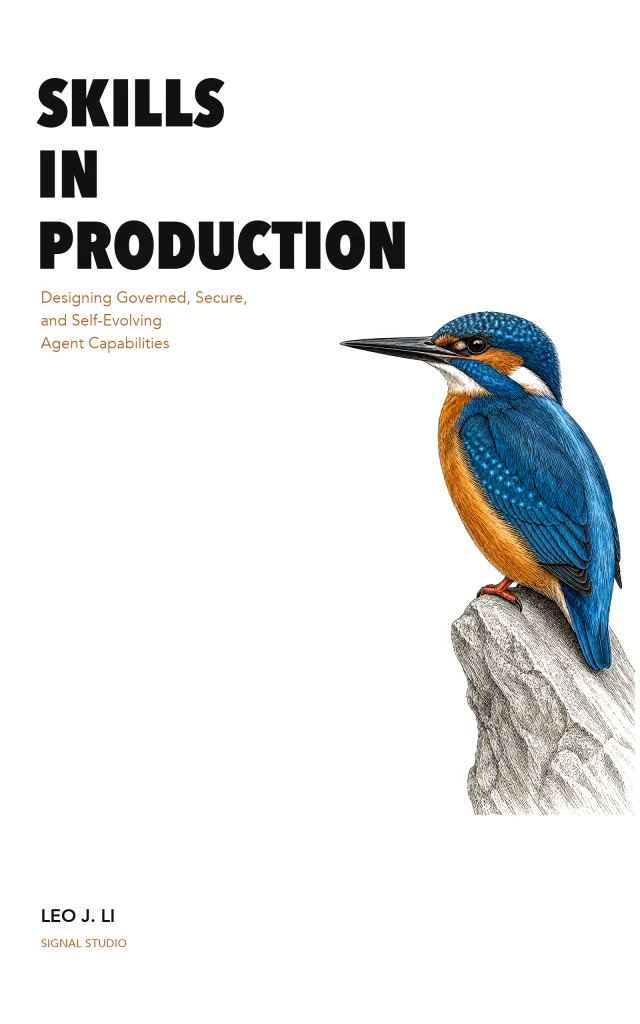
Skills in Production
Designing Governed, Secure, and Self-Evolving Agent Capabilities
A production method for reusable agent skills: capability boundaries, discovery, package identity, release evidence, coexistence, and controlled improvement.
For: agent skill authors, developer productivity teams, AI capability owners
What this book helps you do
This book follows reusable agent skills from a useful folder to an owned production capability. It connects focused authoring and discovery with immutable releases, verifiable evidence, compatible host profiles, fleet operations, and controlled improvement. Readers learn to make the behavior inspectable and recoverable while keeping proposal generation separate from authority to change a shared release.
Problems this book helps you solve
- A useful personal skill has spread across teams without a clear capability owner.
- New descriptions activate for neighboring tasks and displace the correct skill.
- Identical version labels hide different instructions, helper scripts, or references.
- A release passes alone but disrupts the installed skill catalog.
- Signed packages arrive without evidence tied to the exact evaluated bytes.
- Production feedback edits a shared skill without independent regression review.
Start with a practical question
Use a focused guide for the immediate problem, then return here when you need the complete operating method.
- When should a workflow become an agent skill?
- How do you write skill triggers that do not steal neighboring tasks?
- What belongs in SKILL.md, references, and scripts?
- How do you version an agent skill when a tiny edit changes behavior?
- How do you verify that an agent skill is the release you reviewed?
- How do you test whether agent skills can coexist in one catalog?
- How can agent skills improve themselves without promoting their own changes?
Decisions you will be able to make
- Which recurring judgment belongs in a skill and which operations belong in deterministic code.
- How descriptions, core instructions, references, and scripts divide responsibility.
- What compatibility means for triggers, outputs, side effects, tools, and host profiles.
- Which release identities and evidence subjects must match before installation.
- How to detect routing theft and composition failures in the active catalog.
- Who may propose, evaluate, promote, revoke, and retire a capability.
Who this book is for
- Teams turning a growing skill collection into supported production capabilities.
- Authors who need reliable selection, reproducible packages, and useful release evidence.
- Owners evaluating automated skill improvement without allowing self-promotion.
Who this book is not for
- Readers seeking a universal skill folder that behaves identically across every host.
- Teams expecting signatures or one evaluation score to establish behavioral safety.
Reading path
- Name the capability promiseDefine supported work, accepted output, exclusions, dependencies, and safe stops before packaging.
- Author the discovery and execution surfacesUse precise metadata, concise instructions, conditional references, and deterministic helpers.
- Identify and verify the releaseBind source, packaged files, provenance, compatibility evidence, and admission to immutable subjects.
- Test the installed collectionMeasure activation, silence, neighbor displacement, composition, and protected outcomes.
- Operate a recoverable fleetObserve release identity, limit exposure, revoke candidates, and rehearse recovery.
- Govern improvementTurn sanitized failures into reviewable candidates while protecting independent promotion authority.
Start with a capability someone can own
A shared skill changes how an agent discovers work, gathers evidence, chooses tools, and produces a result. The folder format is only the starting point. This book develops the contracts, evidence, ownership, and recovery needed when other people depend on that behavior.
Follow the whole release
The reading path moves from authoring to production identity, release verification, coexistence testing, operation, and controlled evolution. Host-specific deployment profiles remain explicit so that a successful local demonstration does not silently become a portability claim.
Bring one real skill to the method
Choose a capability already used by more than one person. Record its inputs, accepted output, neighboring skills, helper dependencies, and owner. The seven accompanying guides turn those questions into small, independently written decisions and review artifacts.
Evidence and method
The book connects the Agent Skills format, official host documentation, software supply-chain standards, and primary research on evaluation and feedback. Its production profiles and operating model are explicitly author synthesis. Fictional cases explain mechanisms; they do not establish platform performance, universal portability, or safe autonomous self-deployment.
Continue with the Kindle edition
Open the Amazon listing to review the current edition and use Read Sample or Kindle Instant Preview before deciding.
Read a sample
Signal Studio does not reproduce manuscript chapters on this site. Open the Amazon listing to use Read Sample or Kindle Instant Preview
Resources
The related guides contain original inline checklists and decision tables; no manuscript excerpt is republished.
Errata
Editorial QA: automated native-English, structure, metadata, and link checks completed . This record is not an independent expert endorsement. Review boundary.