
Question-led guide · testing
How do you test whether agent skills can coexist in one catalog?
Compare a candidate skill against the installed catalog to detect neighbor displacement, unintended composition, and regressions hidden by isolated tests.
Direct answer
Test a candidate skill inside the catalog users will actually see, comparing that catalog with and without the candidate under the same host profile. Protect neighboring tasks as well as the candidate's own outcomes. Record selected skills, loading order, unintended procedures, and final artifacts. An isolated pass cannot show whether another skill loses its tasks or changes behavior when the candidate becomes available.
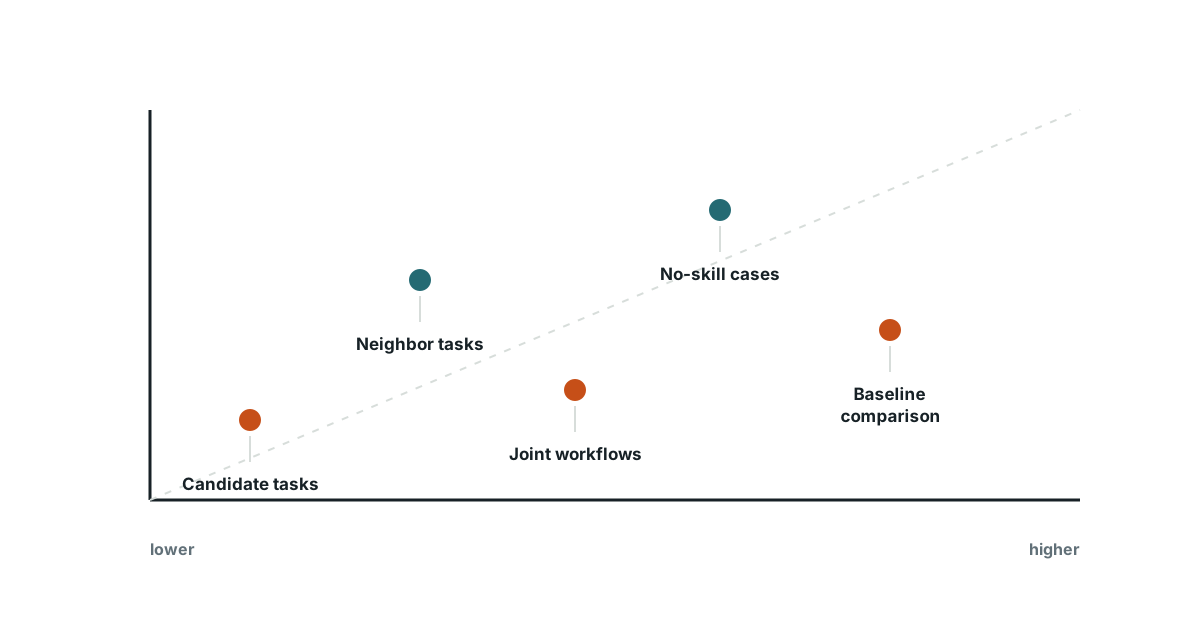
Installation changes the decision environment
An additional skill is more than another folder on disk. Its metadata may enter the host’s discovery context, and its instructions may become available during tasks that previously used another route. The intervention being tested is the changed catalog, not merely the candidate’s ability to complete its own demonstration.
The Claude API guide documents multi-skill availability and composition. A platform’s ability to combine skills is an interface feature; compatibility of a particular collection remains a local question.
Protect established tasks from a new arrival
Select neighbors through shared user intents, file types, tools, output formats, and handoff paths. Include a task that should use the candidate alone, one that should keep using each neighbor, one that legitimately composes capabilities, and one that should use none of them.
Record the complete metadata snapshot the host receives. A test with only two simplified descriptions may miss a third skill that dominates real selection. If the platform changes ordering or retrieves only part of a large catalog, capture that behavior as part of the test conditions.
A spreadsheet skill starts rewriting deck requests
Suppose a hypothetical analytics team installs reconciling-sales-tables alongside drafting-board-decks. The candidate correctly reconciles 24 sales workbooks when tested alone. Its broad instruction to “turn business data into a leadership-ready report” then causes it to load during requests that only ask the deck skill to summarize already approved numbers.
In a constructed comparison, the baseline completes 18 of 20 protected deck tasks. With the candidate installed, 6 of those 20 requests start unnecessary reconciliation and 4 no longer produce the requested deck. These counts illustrate what a report could reveal; they are not observed results from a real system.
Run the catalog intervention matrix
Keep preparation, host profile, and grading conditions comparable across the two catalog states. For stochastic runs, repeat cases and retain trial-level results rather than treating one replay as decisive.
| Task slice | Baseline catalog | Catalog plus candidate | Protected observation |
|---|---|---|---|
| Candidate’s core task | Existing fallback | Candidate available | Intended improvement and accepted output |
| Neighbor’s established task | Neighbor available | Both available | No displacement or artifact regression |
| Legitimate handoff | Current composition | Candidate joins route | Correct order and preserved input meaning |
| Subject-only question | Ordinary response | Candidate visible | Unnecessary activation remains bounded |
| Missing prerequisite | Existing safe stop | Candidate visible | No invented input or forced completion |
| Prior collision case | Recorded baseline | Updated catalog | Known defect does not recur |
The matrix is a proposed method for testing a specific collection. It does not assume that every cell should use the same grader or acceptance threshold.
Observe selection, procedure, and result
Save selected skill identities, file reads or equivalent activation evidence, tool calls, and the final artifact. A correct answer reached through a wrong procedure may incur unnecessary access, cost, or side effects. Conversely, loading an extra harmless reference is not automatically a release-blocking failure.
Define severity before reviewing the candidate results. Anthropic’s evaluation guidance separates regression protection from new capability testing. The same distinction lets a team reject a candidate whose own gains come at the expense of protected neighboring work.
Diagnose interference with a controlled removal
When a regression appears, rerun the failing slice after removing only the candidate or replacing only its metadata. If the effect disappears, the result supports a catalog-interference hypothesis. If it persists, inspect fixture drift, model variation, or an unrelated dependency change.
Do not claim proof from a single disappearance. Repeated, controlled comparisons narrow plausible explanations. Keep the full failing request and permitted context under appropriate data controls so the defect can become a regression case.
Publish compatibility as a bounded report
Report task slices, denominators, candidate and baseline identities, observed serious failures, and untested neighbors. The release decision should state which installed collection was supported; “passed the skill tests” is too broad.
Fix a discovery defect using the trigger boundary worksheet. For deeper grading decisions, see outcome versus trajectory evaluation. Skills in Production connects this narrow coexistence method with the wider release lifecycle. All counts and scenarios here are explicitly constructed web examples.
Evidence
Multiple skills can be available and composed within one Claude API workflow.
The API guide describes metadata discovery, automatic use, and composition of multiple skills in a container.
Primary source · official-doc · checked Sep 8, 2026
Limit: Supported composition does not establish that an arbitrary pair of skills has compatible instructions or reliable routing.
Regression evaluations protect established behavior while capability evaluations measure newly attempted performance.
Anthropic distinguishes capability and regression evaluation and discusses checks over outcomes and tool trajectories.
Primary source · official-doc · checked Sep 8, 2026
Limit: The guidance is a vendor-authored evaluation method and does not supply a validated universal catalog coexistence threshold.
Catalog additions should be evaluated as changes to existing skill behavior, not only as new isolated capabilities.
The catalog intervention matrix compares candidate, neighbor, composition, and absence cases using a pinned catalog snapshot.
Signal Studio author framework · reviewed Sep 8, 2026
Limit: The proposed comparisons can reveal observed interference but cannot exhaust all conversations, catalog orders, or model trajectories.
Limitations
Coexistence evidence is specific to the visible catalog, host, model, task suite, and trial conditions. Interaction sampling does not prove universal compatibility, and hosted systems may expose only part of the skill-selection trajectory.
FAQ
- Do I need to test every pair of installed skills?
- Start with skills sharing task vocabulary, input types, output artifacts, tools, or likely handoffs. Add broader catalog probes and prior failures. Risk-based selection is practical but should be reported as sampled interaction coverage.
- What if the final artifact is correct even though the wrong skill loaded?
- Inspect whether the selection violated a protected boundary or introduced unnecessary work. A harmless extra read and an unauthorized procedure are different severities; the final artifact alone cannot distinguish them.
Related guides
Continue within Agent skills in production, or use one of these adjacent diagnostics:
Editorial QA: automated native-English, structure, source-presence, and link checks completed . This record is not an independent expert endorsement. Review boundary.