
Question-led guide · how-to
What makes an agent test environment reproducible?
A versioned environment manifest for agent tests with controlled state, time, identity, tools, dependencies, faults, resets, and observations.
Direct answer
An agent test environment is reproducible when another runner can reconstruct the same decision-relevant world: seeded data, resource versions, clocks, identity and permissions, tool schemas and behavior, network and dependency conditions, injected faults, observation surface, reset procedure, and grader inputs. Record allowed nondeterminism separately. Reproducibility means controlled claims, not byte-identical trajectories from a stochastic agent.
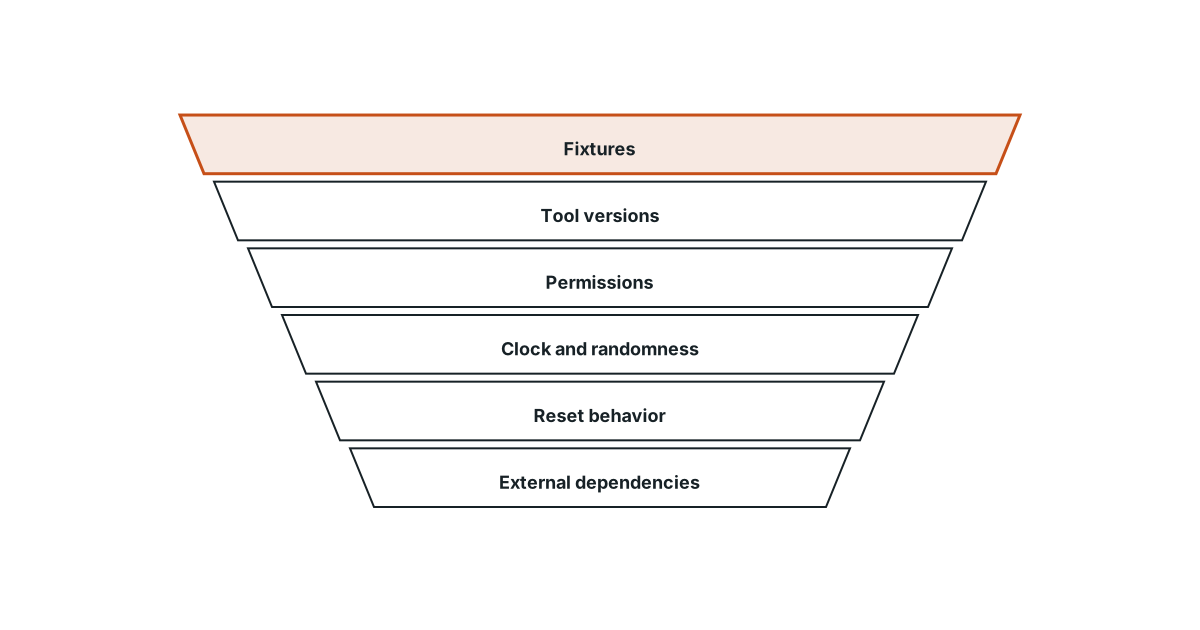
The model is only one moving part
Use this guide for regression suites, capability studies, red-team exercises, and pre-release evaluations of agents that act in stateful environments. It covers the world around the agent. Task selection and trial-count decisions are separate evaluation problems.
How the test world drifts
Agent tests fail for reasons that ordinary input-output fixtures do not capture. A prior run changed a record, the clock crossed a deadline, a test user lost a role, a tool schema changed, a browser retained a session, or an external API returned new data. The model appears to regress or improve when the environment actually moved.
Teams sometimes solve this by mocking everything. The suite becomes repeatable but loses the latency, permission, state, and failure behavior that determines real agent performance. Reproducibility requires a deliberate boundary between controlled fidelity and declared approximation.
A pass caused by a changed tool fixture
Two runs use the same prompt, model, and seed but different CRM fixture states. The manifest records the tool image, dataset snapshot, permissions, virtual clock, network stubs, and reset result, revealing why the later run passed.
Inventory state, versions, clocks, and resets
Run the same test twice after reset and compare a state digest before the agent starts. Include databases, files, queues, browser storage, identities, resource versions, clocks, feature flags, caches, and external fixtures. If the digest differs, identify whether the field is relevant or allowed nondeterminism.
Then replay the same recorded action sequence without the model. Differences expose environment drift. Finally, run two different model configurations against the same prepared snapshot and verify that one run cannot contaminate the other.
Package a reproducible environment manifest
Build environments from versioned recipes and seed packages. Give every test an isolated tenant or namespace and a deterministic setup/teardown lifecycle. Freeze time where the task permits; otherwise record it and define acceptable time behavior. Use short-lived test identities with explicit scopes.
Pin tool contracts and adapter versions. For external dependencies, choose among a pinned simulator, recorded contract fixture, dedicated test service, or live sandbox, and label the resulting fidelity. Inject faults through controlled mechanisms rather than hoping for natural errors.
Before scoring, run health and reset checks. After the test, capture end-state evidence and clean up effects. Quarantine the result if setup, observation, or reset checks fail.
Test-environment manifest
The test-environment manifest contains:
| Area | Required record |
|---|---|
| Environment identity | Image, code, schema, seed, region, and configuration versions |
| Initial state | Resource inventory and pre-run state digest |
| Time and randomness | Clock policy, timezone, seeds, and allowed nondeterminism |
| Identity and policy | Test actors, roles, tokens, target scopes, and policy version |
| Tools | Schemas, adapter builds, rate limits, errors, and side-effect semantics |
| Dependencies | Simulator/live status, contract version, data snapshot, and known drift |
| Faults | Injection point, trigger, duration, cleanup, and observability |
| Observations | Screens, APIs, telemetry, logs, and hidden evaluator state |
| Reset | Procedure, verification digest, timeout, and quarantine behavior |
| Provenance | Builder, capture time, change history, and artifact hashes |
Reproduction claims based on prompt and seed alone
- Resetting the database but retaining browser sessions, queues, caches, or files.
- Pinning model settings while tool and dependency versions drift.
- Letting failed setup runs enter the score denominator as agent failures.
- Mocking away permissions and latency that the agent must handle in production.
- Allowing one stochastic run to change fixtures for the next trial.
Evidence
Stateful web-agent evaluation benefits from self-hosted, resettable sites with executable end-state checks.
WebArena introduces a benchmark environment with realistic self-hosted websites, tasks, and functional correctness evaluation.
Primary source · paper · checked Aug 26, 2026
Limit: The environment approximates a subset of web activity and cannot reproduce arbitrary production integrations or users.
Computer-use evaluation is sensitive to operating-system state, software versions, setup, and observation/action interfaces.
OSWorld defines a real-computer environment and tasks across applications, with setup and evaluation infrastructure for multimodal agents.
Primary source · paper · checked Aug 26, 2026
Limit: OSWorld's applications, versions, and tasks are bounded and still differ from a company's production desktops and policies.
A test result should name the environment version and reset proof that bound the result.
The manifest below separates controlled state from declared nondeterminism and records whether reset actually succeeded.
Signal Studio author framework · reviewed Aug 26, 2026
Limit: Some external services cannot be pinned or fully simulated; such dependence must narrow the evaluation claim.
Limitations
Perfect reproducibility is unattainable when models, external APIs, clocks, networks, or hosted dependencies change. Simulators may also remove important production behavior. The manifest makes those limits visible but does not eliminate them.
FAQ
- Does reproducible mean the agent must take the same path every run?
- No. Stochastic trajectories may differ. The initial world, available actions, policy, observations, and grading conditions should be controlled so differences can be attributed and reported.
- Can I evaluate directly against a live SaaS product?
- Only with narrow claims and strict safety controls. Live services drift and can create real effects; capture versions and state where possible, use test tenants, and report uncontrolled dependencies.
Related guides
Continue within AI agent evaluation, or use one of these adjacent diagnostics:
Editorial QA: automated native-English, structure, source-presence, and link checks completed . This record is not an independent expert endorsement. Review boundary.