
Question-led guide · comparison
When does an AI agent need a platform instead of a simple service?
Decide whether shared agent infrastructure is warranted by production obligations, repeated ownership gaps, and the cost of maintaining another operating layer.
Direct answer
An agent needs shared platform machinery when several workloads depend on the same production guarantees and ordinary services cannot provide those guarantees consistently at acceptable cost. Start with obligations such as durable acceptance, controlled releases, tenant scheduling, and operator intervention. Keep a simple service when its work is bounded, safely restartable, and already governed by existing infrastructure. Agent complexity alone does not justify another platform.
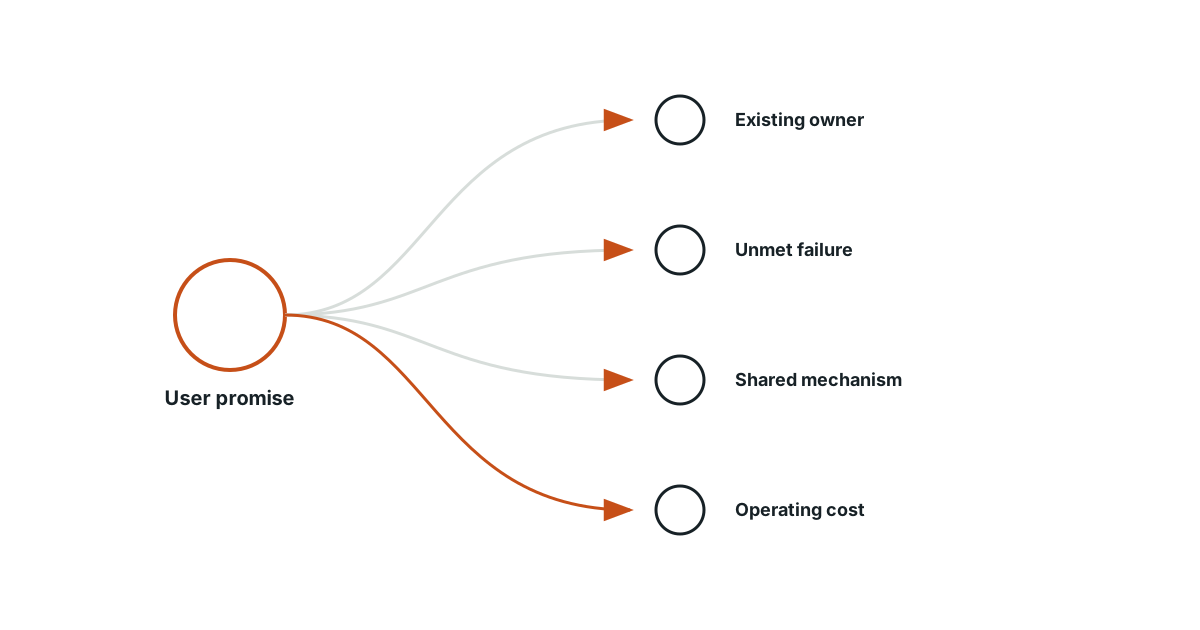
Name the obligation before naming the platform
The useful starting question is what the service promises after it accepts work. A formatting assistant may promise a response within twenty seconds or an explicit failure. An investigation service may promise to retain a task overnight, resume after a deployment, and let an operator stop pending changes. Those promises create different engineering obligations even if both use the same model SDK.
Write the promise in user-observable terms. Then identify the component and team responsible for keeping it. A diagram containing a queue, database, and worker is incomplete until someone owns the cases where those components disagree.
Shared mechanisms have their own operating cost
A platform can reduce repeated implementation, but it also creates a dependency for every adopter. Its interfaces need compatibility rules, migrations, support, capacity, incident response, and an exit path. Centralizing a weak implementation merely distributes its failure more widely.
The economic comparison is repeated local work versus the full cost of providing a dependable shared capability. Five teams using different models is weak evidence for centralization. Five teams separately maintaining task admission, release attribution, and a staffed recovery console is a stronger signal, provided their requirements genuinely agree.
Two assistants with very different promises
Consider two hypothetical internal products. A writing assistant handles 300 requests per day, performs no external writes, and allows the user to retry a failed request. Existing authentication and request telemetry cover its operating needs. A conventional web service is a plausible starting point.
A second product accepts 40 investigations per day. Each may wait six hours for a reviewer, call tools owned by three teams, and survive a weekly worker rollout. Its volume is smaller, but acceptance creates a longer obligation. A durable execution service and explicit release policy can address concrete gaps. This does not yet establish that the company needs a general-purpose platform for every agent.
Use an obligation decision record
Complete this artifact with an existing system name rather than a proposed product category. A missing owner is a decision to resolve, not permission to add another component.
| Obligation | Existing owner and evidence | Unmet case | Smallest justified addition |
|---|---|---|---|
| Accepted work survives process replacement | Job service; replacement drill | None for bounded batch work | Reuse current job contract |
| Human waits survive release cycles | No current owner | Reviewer responds after old workers retire | Durable wait and compatible executor |
| Behavior revisions are attributable | Image registry only | Prompt changes without a release record | Release manifest and resolver |
| One tenant cannot monopolize capacity | Shared FIFO queue | Bulk jobs block urgent requests | Tenant-aware scheduler |
| An operator can stop affected work | Application-specific scripts | New workloads lack a supported control | Owned intervention interface |
The filled rows above are illustrative. For a real decision, add an accountable owner, operating estimate, failure test, and date to revisit each addition.
Prove one boundary before generalizing it
Select one recurring failure and run the same drill in the current service and proposed mechanism. For example, replace a worker after task acceptance and inspect the user-visible result. Assess whether the candidate actually closes the obligation and whether its support burden is acceptable. Queue delivery guarantees still need application interpretation: SQS documents possible redelivery.
Do not claim production readiness from a happy-path demonstration. Retain the drill record, unresolved cases, and operating owner. The detailed recovery design belongs in resuming a long-running agent safely.
Preserve an off-ramp for the first adopter
Define the minimum adoption interface and how a workload can leave. Keep domain decisions in the application unless they are demonstrably shared. A platform that requires every team to adopt one prompt style, one business state machine, and one model before it provides basic admission is imposing product coupling along with infrastructure.
Review the choice after actual adoption. If the second workload needs a fundamentally different guarantee, narrow the shared boundary rather than expanding an abstraction until it hides the differences.
Where the decision remains local
NIST’s Generative AI Profile supports lifecycle governance, not a particular topology. This guide’s decision record is a proposed way to assign those responsibilities. It cannot determine staffing, consequence tolerance, or a vendor’s actual guarantees. Compare the burden of a new boundary using the microservice architecture decision, then continue with the broader method in AI Agent Platform Engineering.
Evidence
A standard queue can deliver a message more than once, so selecting a queue does not remove duplicate-processing obligations.
Amazon SQS documents at-least-once delivery and advises applications to tolerate repeated message delivery.
Primary source · official-doc · checked Sep 8, 2026
Limit: This establishes one broker's delivery behavior, not a requirement to adopt an agent platform.
Generative AI risk management includes lifecycle responsibilities that extend beyond a successful prototype demonstration.
NIST's Generative AI Profile includes governance, pre-deployment testing, monitoring, and incident-management considerations.
Primary source · standard · checked Sep 8, 2026
Limit: The voluntary profile does not prescribe a platform architecture or a numerical build-versus-buy threshold.
Limitations
The decision record is an author-created architecture method, not a validated maturity scale. Local workload consequences, existing infrastructure, staffing, and vendor contracts determine whether a shared platform reduces total risk and work.
FAQ
- Does using several agents automatically require a platform?
- No. Several bounded computations can run inside an ordinary service. The decision turns on durable obligations, independent change, shared controls, and operational ownership rather than agent count.
- Should a team build its own orchestration runtime?
- Only after an explicit requirement remains unmet by existing services or managed products. Compare semantic guarantees and operating burden using a failure exercise, not a feature inventory alone.
Related guides
Continue within AI agent platform engineering, or use one of these adjacent diagnostics:
Editorial QA: automated native-English, structure, source-presence, and link checks completed . This record is not an independent expert endorsement. Review boundary.