
Question-led guide · how-to
How should an agent platform separate its control plane from execution?
Design explicit outage behavior for agent configuration, task execution, evidence storage, and emergency controls using a dependency survival matrix.
Direct answer
Separate configuration publication and administrative change from the path that executes accepted tasks. Give workers verified, immutable release references and define which operations may continue if the control service is unavailable. Keep commit-time authorization and emergency revocation requirements explicit; cached configuration must not silently extend permission. Test the dependency graph, including bootstrap, identity, evidence, and recovery paths, rather than relying on separate service names.
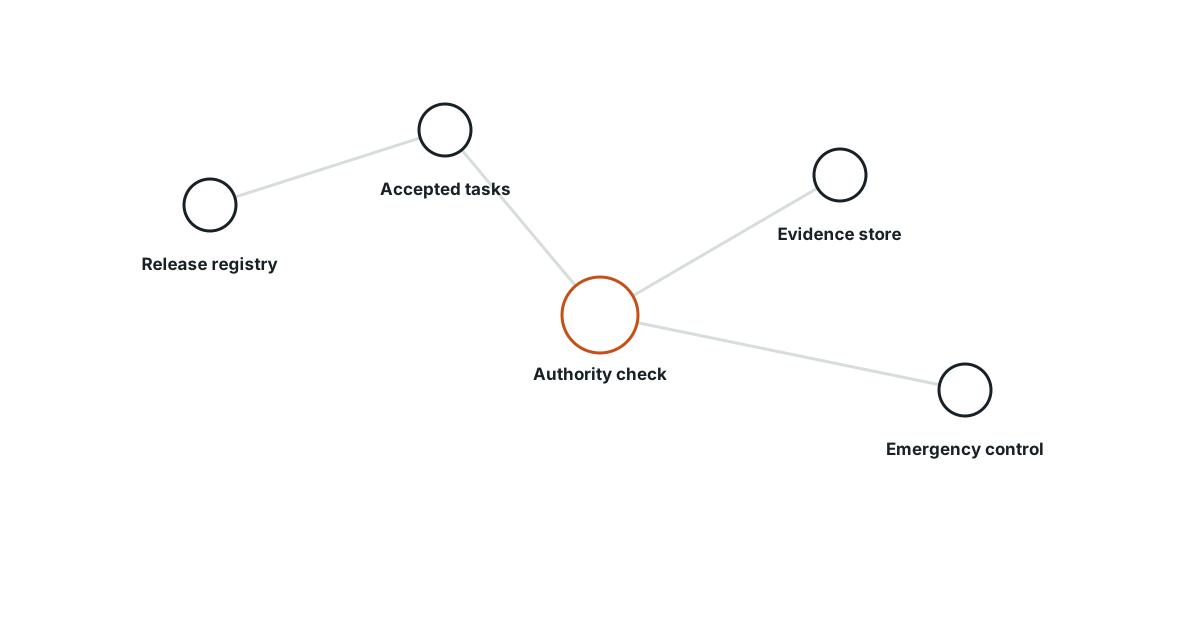
Configuration publication is a different operation from task execution
The control plane publishes revisions, changes routing, admits new tool definitions, and administers tenants. The execution plane performs work already accepted under a resolved revision. Separating those responsibilities lets a configuration outage freeze new changes without automatically stopping every eligible read-only task.
This separation is semantic before it is physical. Two deployments that both fetch mutable configuration from the same unavailable database on every step remain coupled. Conversely, one modest service can keep its interfaces distinct before separate scaling or failure domains are justified.
A cached release is not cached authority forever
Workers may retain the exact prompt and tool definition they already verified. That answers which behavior to execute. It does not answer whether an actor may still perform a consequential action. Fresh permission checks, revocation requirements, and expiry remain governing constraints.
An outage policy therefore names specific operations. Continuing a calculation over already authorized data is different from issuing a new write after an authorization service becomes unreachable. The latter must follow its established authorization contract. The detailed time boundary belongs in approval and authority expiry.
A configuration outage during twelve investigations
Imagine a fictional service with twelve active investigations when its release registry becomes unavailable. Nine are producing read-only summaries from already retrieved evidence. Two need a new tool revision that has not been resolved. One is about to request permission to publish a change.
The proposed policy lets the nine finish using verified local assets while recording registry unavailability. The two unresolved tasks wait with a visible reason. The pending publication waits because its required authority decision cannot be established. New releases freeze. This is useful partial service, provided the evidence store and user status path remain healthy.
Write a survival matrix that operators can execute
Use one row per failed dependency. Replace the illustrative decisions with the system’s actual permission, durability, and retention contracts.
| Dependency lost | Permitted continuity | Stop condition | Recovery evidence |
|---|---|---|---|
| Release registry | Already resolved revisions only | Required asset missing or revoked | All required asset digests resolve |
| Authorization service | Previously authorized bounded computation | New authorization required or grant expired | Fresh decision path verified |
| Evidence export backend | Bounded local spool, if policy permits | Spool full or mandatory receipt unavailable | Backlog drained and gaps enumerated |
| Administration UI | Existing task processing within policy | Intervention cannot be applied safely | Independent stop control exercised |
| Task system of record | No new durable acceptance | A transition cannot be committed | Authoritative state and ownership reconciled |
For every cell, record the deciding component and observable reason code. A dashboard banner saying “degraded” is too broad to tell an operator which action remains safe.
Test the path that restores the control plane
Draw dependencies for starting a replacement worker and restoring an administrator session. Include certificate issuance, image access, configuration decryption, DNS, and database credentials. A running worker may survive with warm connections while every replacement fails to start.
Cloudflare’s November 2023 postmortem shows why hidden dependencies deserve explicit drills. Its incident is not an agent case; the transferable question is whether a tested component outage actually removed all the dependencies of the broader failure domain.
Restore capacity gradually after the registry returns
Recovery can produce a second disturbance when waiting tasks, refreshing workers, and administrators reconnect together. Bound asset refresh and task admission separately. First establish that the intended revision and stop controls are trustworthy, then expand work within downstream headroom.
Google’s cascading-failure discussion supports assessing feedback and dependency pressure. The exact recovery ramp remains a local operating choice. Verify that recovery metrics distinguish refreshed assets from accepted tasks and completed work.
What a diagram cannot establish
Logical planes do not prove physical isolation, safe offline operation, or an acceptable revocation delay. The design needs dependency-loss tests and a named owner for each degraded mode. Continue with packaging a complete agent release and the integrated operating model in AI Agent Platform Engineering.
Evidence
A control-plane outage can coexist with continued service elsewhere while hidden dependencies complicate recovery.
Cloudflare's first-party postmortem documents its November 2023 control-plane and analytics outage, missing dependency coverage, and recovery difficulties.
Primary source · official-doc · checked Sep 8, 2026
Limit: This is a report about Cloudflare infrastructure, not evidence that a proposed agent platform has equivalent isolation.
Overload and dependencies can propagate failure, so a service's recovery behavior must be assessed beyond its own process health.
Google's SRE chapter explains cascading-failure mechanisms and measures for reducing overload and failure propagation.
Primary source · official-doc · checked Sep 8, 2026
Limit: The chapter establishes general reliability mechanisms and does not validate this guide's specific outage policy.
Limitations
The matrix describes an author-created availability policy. Actual continuity depends on data consistency, token expiry, revocation latency, storage limits, and recovery access. A first-party infrastructure incident supplies a mechanism to investigate, not a performance prediction for agents.
FAQ
- Can workers always continue with cached policy?
- No. A cached behavior revision does not extend an expired grant or satisfy a required fresh authorization check. Define allowed continuity separately for each operation and authority boundary.
- Does a separate control-plane database establish isolation?
- It removes one possible shared dependency, but bootstrap, identity, routing, secrets, deployment, and evidence services can still couple the planes. Test actual loss of dependencies.
Related guides
Continue within AI agent platform engineering, or use one of these adjacent diagnostics:
Editorial QA: automated native-English, structure, source-presence, and link checks completed . This record is not an independent expert endorsement. Review boundary.