
Question-led guide · diagnostic
What should an SRE agent do when telemetry is missing?
A safe observation-gap protocol for incident agents that encounter sampling, collector loss, absent instrumentation, or an unobserved dependency.
Direct answer
When telemetry is missing, an SRE agent should treat the gap as evidence about observability—not as permission to invent the missing event. It should identify the expected signal, classify why it may be absent, reduce the strength of affected claims, seek an independent source, and stop or hand off when the gap prevents competing hypotheses from being distinguished safely.
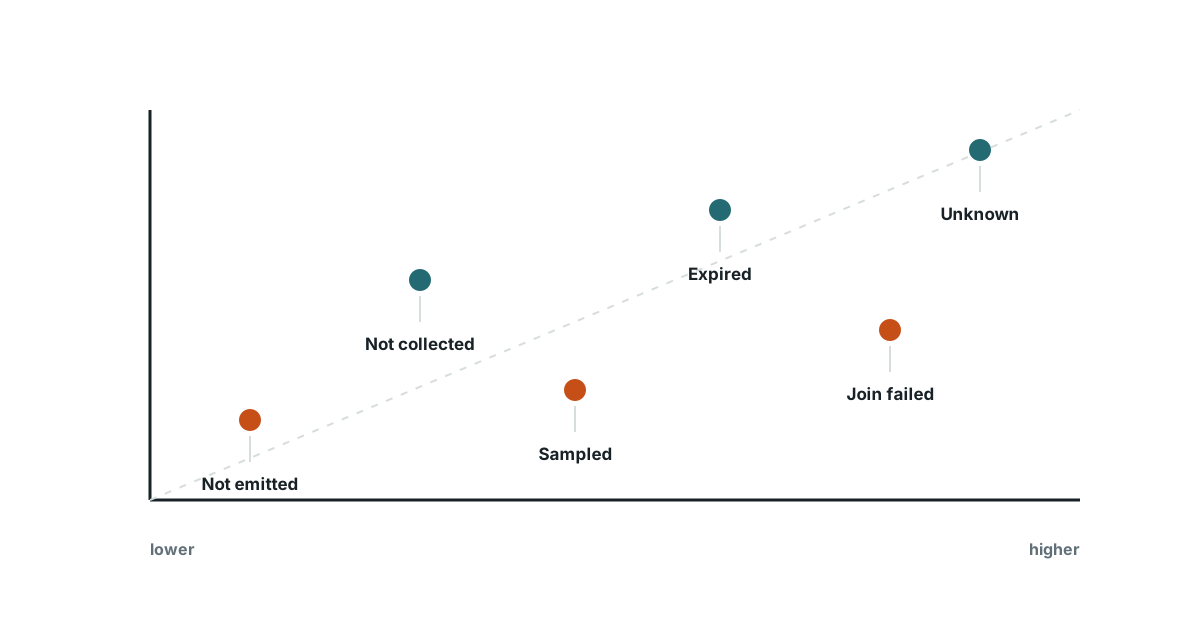
Missing telemetry is an observed condition
Apply this protocol when an incident agent expects a span, metric series, log event, resource attribute, change record, or topology edge and cannot find it. The objective is to preserve epistemic safety while still making progress. This page is about the agent’s behavior under incomplete observation, not about designing an organization-wide telemetry pipeline.
How gaps become false negatives
Missing telemetry has several causes with different implications. A request may be intentionally head-sampled, a collector may drop data under pressure, a library may not instrument an asynchronous boundary, a query may use the wrong resource identity, or retention may have expired. The event may also genuinely not have occurred.
Agents often collapse all of these cases into one of two bad responses: they ignore the gap and finish the story, or they refuse the entire investigation. Both lose useful information. A controlled system separates what was expected, what was observed, why the difference matters, and which safer source can reduce uncertainty.
No logs from the failing pod
The agent discovers that the collector restarted and dropped logs during the incident. It does not conclude that the pod emitted no errors; it records the collection gap, uses traces and metrics within their limits, and requests a human check.
Classify the gap before continuing
Classify the gap before changing the incident conclusion:
- Expected absence: policy or sampling predicts that some records will be missing.
- Collection loss: the signal should exist, but SDK, network, collector, export, or backend health is degraded.
- Instrumentation gap: the code path or external boundary never produced the signal.
- Identity/query mismatch: the record exists under another tenant, namespace, service, version, or time basis.
- Retention/access gap: the record existed but is expired, redacted, or outside current authority.
- Possible true absence: the observation process was healthy enough that non-occurrence is plausible.
Check telemetry health independently of application health. Collector queue metrics, export errors, sampling configuration, deployment history, and known coverage maps are evidence about the observation system itself.
Lower the claim or acquire new evidence
Require the agent to emit an observation-gap event whenever missing data affects a material hypothesis. The event should reduce the affected claim level automatically. For example, a missing downstream span may allow localized near service A but block dependency B caused the incident.
Provide bounded fallbacks: load-balancer access logs, cloud audit events, deployment records, database health, synthetic probes, or a healthy control cohort. Each fallback needs its own identity and clock reconciliation. Never paste a low-trust source into the context without labeling its origin.
Set stop rules by consequence. If the next step is a reversible read-only query, the agent may continue. If the gap hides the target, actor, or blast radius of a production change, it should hand off before acting.
Observation-gap card
Create one card for each consequential gap:
| Field | Example question |
|---|---|
| Expected signal | Which span, log, metric, change, or topology record should exist? |
| Expectation basis | Which instrumentation version, policy, or coverage test creates that expectation? |
| Gap class | Sampling, loss, instrumentation, identity, retention/access, or possible true absence? |
| Affected claim | Which diagnosis becomes weaker or impossible? |
| Claim downgrade | What is the strongest statement still supported? |
| Fallback source | Which independent source can be queried, under what authority? |
| Reconciliation | How will identity, clock, scope, and semantics be aligned? |
| Owner and expiry | Who repairs the gap, and when must it be reviewed? |
Language that hides unknown coverage
- Writing “no evidence of X” when the collection path for X was unhealthy.
- Treating a sampled trace as a complete request population.
- Filling a missing field from model memory without marking it as inference.
- Joining fallback records by service display name rather than stable resource identity.
- Continuing to remediation when the missing evidence hides impact, ownership, or reversibility.
Evidence
A sampling decision can make a trace non-recording, and recording and sampling behavior are explicit parts of the tracing SDK.
The OpenTelemetry tracing SDK specification defines samplers, recording decisions, sampled flags, and span processor behavior.
Primary source · standard · checked Aug 26, 2026
Limit: The specification describes intended SDK behavior; it does not reveal whether a particular missing span was sampled out, dropped later, or never instrumented.
OpenTelemetry defines multiple signals and shared context, but no one signal is guaranteed to contain a complete operational history.
The specification overview separates traces, metrics, logs, baggage, resources, and context propagation and describes their respective roles.
Primary source · standard · checked Aug 26, 2026
Limit: Signal definitions do not measure the completeness, accuracy, retention, or queryability of a team's deployment.
An observation gap should carry an owner, consequence, fallback query, and expiry instead of becoming an invisible caveat.
The observation-gap card turns missing evidence into an operational object that can constrain the diagnosis and trigger repair.
Signal Studio author framework · reviewed Aug 26, 2026
Limit: Local teams must define which gaps are tolerable at each severity and which alternate data sources are trustworthy.
Limitations
The protocol cannot reconstruct evidence that was never captured and may not distinguish instrumentation failure from genuine absence. Fallback data can have different clocks, identities, retention, and semantics, so cross-source agreement must be checked rather than assumed.
FAQ
- Can the agent infer a missing span from neighboring spans?
- It can label an inferred transition as a hypothesis, but it must not present that transition as observed. The inference needs assumptions, alternatives, and a consequence for claim strength.
- Does no log entry mean an event did not happen?
- Usually not. Absence can reflect logging level, sampling, buffering, loss, retention, query scope, or missing instrumentation. A negative claim requires evidence that the observation process would reliably have recorded the event.
Related guides
Continue within AI agents for SRE and root cause analysis, or use one of these adjacent diagnostics:
Editorial QA: automated native-English, structure, source-presence, and link checks completed . This record is not an independent expert endorsement. Review boundary.