
Question-led guide · diagnostic
How do forward-deployed teams avoid permanent custom development?
A practical escape from customer-specific code through bounded experiments, pattern thresholds, productization decisions, ownership, and deletion dates.
Direct answer
Prevent permanent custom development by treating every customer-specific change as a time-bounded hypothesis, not a quiet product commitment. Define the customer outcome, reusable assumption, isolation boundary, owner, support level, evidence threshold, review date, and deletion or migration path before building. Then classify the result: configuration, reusable extension, core product capability, partner work, or rejected exception. Productization requires repeated evidence and an accountable product owner; customer urgency alone is not the threshold.
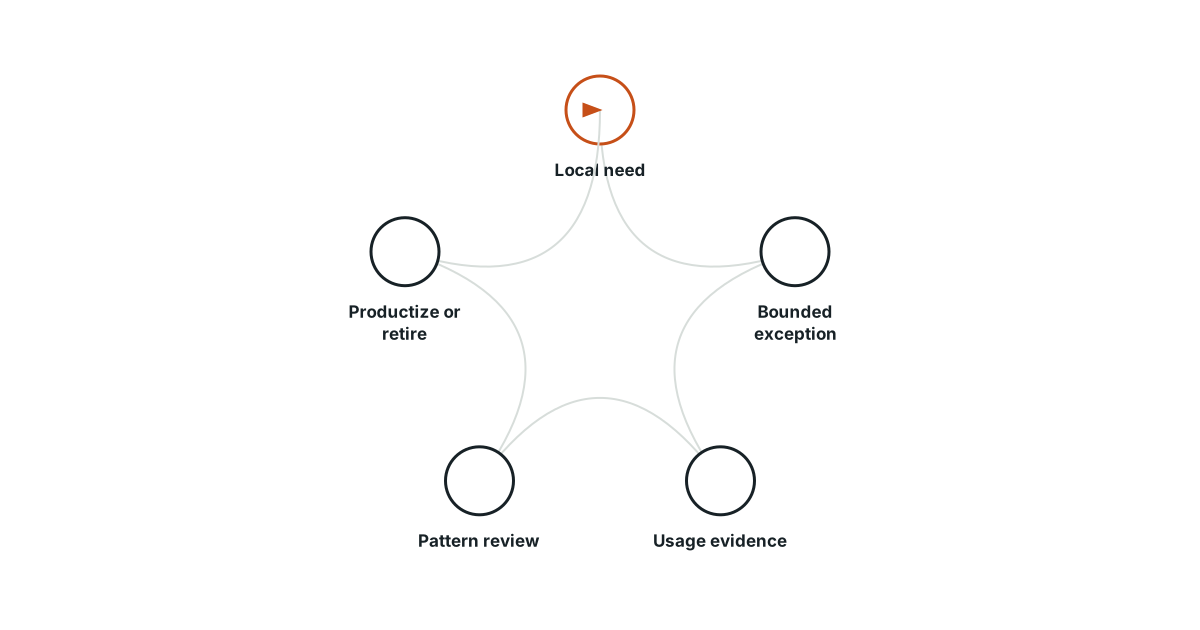
The exception needs a return path
Use this method when an FDE or customer engineering team can modify integrations, workflows, data models, user interfaces, or core services for an individual account. The goal is not to eliminate all customer-specific work; it is to stop temporary learning mechanisms from becoming invisible permanent products.
Why useful field code becomes invisible debt
The first customer has a deadline and a concrete problem. The reusable abstraction is still uncertain, so a narrow custom change is often rational. Trouble begins when the change has no lifecycle. A second customer gets a variation, support inherits both, and core engineering cannot safely upgrade either. Revenue conceals the accumulating maintenance surface.
Teams also productize too early. They generalize from one environment, add configuration for imagined variants, and make the core product more complex before the pattern is understood.
The fourth customer-specific identity mapper
Three deployments use separate scripts for the same identity mismatch. The fourth request triggers a pattern review; the team defines a supported mapping extension, migrates existing customers, and gives each script a retirement date.
Inspect repetition, ownership, and exit
Build an inventory of field-created changes and ask:
- Which customer outcome and contract depend on this change?
- Is it isolated behind a supported extension or does it fork core behavior?
- Who owns reliability, security, upgrades, support, and cost?
- What observation would prove that the pattern recurs?
- What observation would prove that the abstraction is wrong?
- When is the next keep, productize, migrate, or delete decision?
- Can the customer move to the standard path without a new project?
Anything without answers is already a form of product debt, even if the code is small.
Create a disposition loop
Open an exception record before implementation. State the outcome, hypothesis, narrow boundary, permitted customers, support class, owner, telemetry, evidence threshold, review date, and exit path. Keep the change behind a versioned extension interface where possible and prohibit hidden modifications to the shared core.
At review, choose one destination:
- Configuration: supported variation inside a stable product boundary.
- Reusable extension: a governed module with compatibility and ownership rules.
- Core product: a repeated strategic need with a coherent abstraction and product owner.
- Partner or services: valuable work that does not belong in the product economics.
- Retire: migrate the customer and delete the exception.
Fund productization as product work. Moving code into a shared repository without documentation, migration, reliability, security, adoption, and support ownership is relocation, not productization.
Exception ledger
Maintain this exception ledger:
| Field | Required decision |
|---|---|
| Outcome | Measurable customer workflow change |
| Hypothesis | Reusable problem or mechanism being tested |
| Boundary | Where custom behavior is isolated |
| Owner | Reliability, security, support, and product decision owner |
| Evidence | Usage, recurrence, operating cost, failure, and feedback signals |
| Review | Date and decision forum |
| Destination | Configure, extend, productize, partner, or retire |
| Exit | Migration and deletion plan |
Engagement habits that institutionalize bespoke work
- Calling code reusable because it is stored in a shared repository.
- Counting customer requests without comparing the underlying workflow and constraints.
- Leaving experiments in production without a review date or deletion path.
- Making FDEs responsible for lifetime support after product teams decline ownership.
- Adding switches to the core product for every exception.
- Productizing before the team understands which parts of the first solution were accidental.
Evidence
Reusable platform boundaries and defined layers help separate product capability from application-specific implementation.
Palantir's first-party architecture guidance describes platform thinking and reusable foundations for applications and workflows.
Primary source · official-doc · checked Aug 25, 2026
Limit: The guidance describes one platform ecosystem and does not supply a universal economic threshold for productization.
Field learning should be transferred beyond the initial embedded engagement.
PagerDuty's account connects embedded customer problem solving with a broader forward-deployed engineering model.
Primary source · official-doc · checked Aug 25, 2026
Limit: This company narrative does not measure which productization governance performs best across organizations.
Every exception needs an explicit destination and decision date to avoid becoming an accidental permanent surface.
The Signal Studio exception ledger forces classification, isolation, ownership, evidence, review, migration, and deletion decisions.
Signal Studio author framework · reviewed Aug 25, 2026
Limit: This is an author-created governance tool and must be integrated with local commercial and support obligations.
Limitations
Commercial commitments may constrain deletion or migration. This framework does not alter contracts and should be paired with legal, support, security, and account decisions where relevant.
FAQ
- How many customers justify productization?
- There is no universal number. Require evidence of a repeated problem, strategic fit, acceptable operating cost, coherent abstraction, and a named product owner—not a raw request count.
- Is customer-specific configuration always bad?
- No. Configuration is healthy when it uses supported boundaries, remains observable and upgradeable, has an owner, and does not silently fork core behavior.
Related guides
Continue within Forward deployed engineering, or use one of these adjacent diagnostics:
Editorial QA: automated native-English, structure, source-presence, and link checks completed . This record is not an independent expert endorsement. Review boundary.