
Question-led guide · comparison
Ontology, taxonomy, knowledge graph, or semantic layer: which one do you need?
A decision guide for choosing controlled vocabularies, relationship models, graph representations, and governed analytical meaning without buying labels.
Direct answer
Choose by the decision you must make, not by the fashionable label. Use a taxonomy for governed categories and broader–narrower navigation; an ontology for explicit classes, relations, constraints, and machine-interpretable meaning; a knowledge graph for connected entities and facts with provenance; and a semantic layer for consistent business measures and dimensions. These can coexist. The hard work remains identity, ownership, evidence, temporal meaning, and change control.
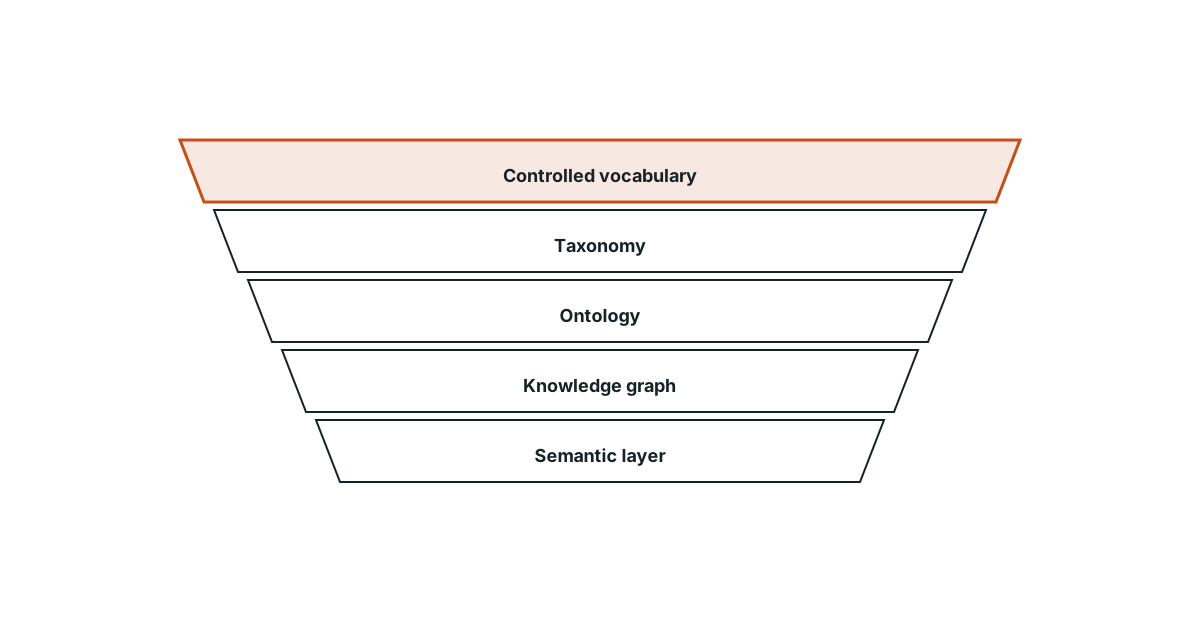
Choose the artifact by the decision
Use this comparison when teams agree that data needs more meaning but disagree about the artifact to build. Begin with a workflow such as asset impact analysis, product reporting, access control, search, incident response, or customer-entity resolution.
Why semantic terms collapse into one another
The four terms are often used as product categories, so architecture discussions begin with a technology and work backward. A team may build a graph when it only needs a controlled list, or a formal ontology when it cannot yet maintain stable identifiers. Another team may call a metric catalog a semantic layer even though definitions, joins, ownership, and time rules remain inconsistent.
The result is a sophisticated representation of unresolved organizational disagreement.
Incident categories do not require an ontology—yet
A team first needs consistent incident labels and hierarchy, so a controlled vocabulary and taxonomy suffice. Cross-system identity, temporal relations, and validation later justify an ontology and knowledge graph.
Separate labels, constraints, instances, and access
Write the decision and the semantic failure that currently prevents it. Then ask:
- Do users mainly disagree about labels and category boundaries?
- Must the system express typed entities, relations, constraints, or inference rules?
- Are multi-hop relationships, provenance, and changing facts central to the query?
- Do consumers mainly need consistent measures, dimensions, joins, and time semantics?
- Who owns identity resolution, definition changes, conflicts, and exceptions?
- How quickly must the representation reflect a real-world change?
If ownership and refresh cannot be answered, choosing a richer model increases stale certainty rather than useful meaning.
Build only the layers the workflow needs
Adopt the smallest useful layer and add complexity only when a decision requires it:
| Need | Start with | Core governance question |
|---|---|---|
| Consistent vocabulary and navigation | Taxonomy | Who owns concept, label, hierarchy, and mapping changes? |
| Explicit domain meaning and constraints | Ontology | Which inferences are valid, and who accepts their consequences? |
| Connected facts and provenance | Knowledge graph | How are identity, source, observation time, and confidence represented? |
| Consistent analytical measures | Semantic layer | Who owns metric formulas, joins, grains, filters, and effective dates? |
The layers can share identifiers and definitions. A taxonomy can provide labels for ontology classes; an ontology can define relations used in a graph; a semantic layer can compute governed measures from graph or tabular data. Do not merge their responsibilities into one unlabeled object.
Version definitions and mappings. Preserve observed time, effective time, source, and confidence for facts that can change. Test the semantic system with real decisions: whether two users obtain the same measure, whether an impact query finds known dependencies, or whether a prohibited inference is blocked.
Semantic decision canvas
For one workflow, complete this semantic decision canvas:
| Field | Answer |
|---|---|
| Decision | What action or conclusion will the model support? |
| Consumer | Person or system using it |
| Required concepts | Terms that must be shared |
| Required relations | Connections that affect the decision |
| Required measures | Formula, grain, filters, units, and time semantics |
| Evidence | Source, provenance, confidence, observed and effective time |
| Owner | Definition, mapping, exception, and quality owners |
| Freshness | Maximum acceptable lag and detection method |
Projects that start with a graph before a question
- Buying a graph database before defining the decision and identity rules.
- Calling a hierarchy an ontology because the name sounds more capable.
- Treating a metric name as a definition while grain, filters, and time windows differ.
- Omitting provenance and temporal meaning from facts that can change.
- Assuming formal logic makes source data correct.
- Letting an LLM resolve contested business definitions without accountable owners.
Evidence
A taxonomy can represent concepts, labels, and hierarchical or associative relationships in a controlled vocabulary.
The W3C SKOS Reference defines a model for concept schemes, labels, broader and narrower relationships, and mappings.
Primary source · standard · checked Aug 25, 2026
Limit: SKOS intentionally supports concept schemes and does not provide every logical constraint associated with richer ontologies.
An ontology language can formally describe classes, properties, individuals, and logical relationships.
The W3C OWL 2 Overview describes a language for ontologies with classes, properties, individuals, and machine-processable semantics.
Primary source · standard · checked Aug 25, 2026
Limit: Formal expressiveness introduces modeling and reasoning costs and does not ensure source data is accurate or current.
The correct semantic investment is the smallest governed model that improves a named decision or workflow.
The Signal Studio decision-first semantic ladder ties vocabulary, relations, evidence, computation, and governance to observable operational use.
Signal Studio author framework · reviewed Aug 25, 2026
Limit: This is an author-created selection framework; product names may use these terms differently.
Limitations
Vendor usage of these terms varies. This guide presents functional distinctions rather than certifying any product category, query language, or reasoning engine.
FAQ
- Is every knowledge graph an ontology?
- No. A graph can hold entities and edges with little formal semantics, while an ontology describes meaning and constraints. A system may use both, but the terms are not interchangeable.
- Can an LLM create the semantic model automatically?
- It can propose mappings and detect patterns, but accountable owners must resolve identity, definitions, conflicts, temporal rules, and consequences of incorrect inferences.
Related guides
Continue within Ontology and operational semantics, or use one of these adjacent diagnostics:
Editorial QA: automated native-English, structure, source-presence, and link checks completed . This record is not an independent expert endorsement. Review boundary.