
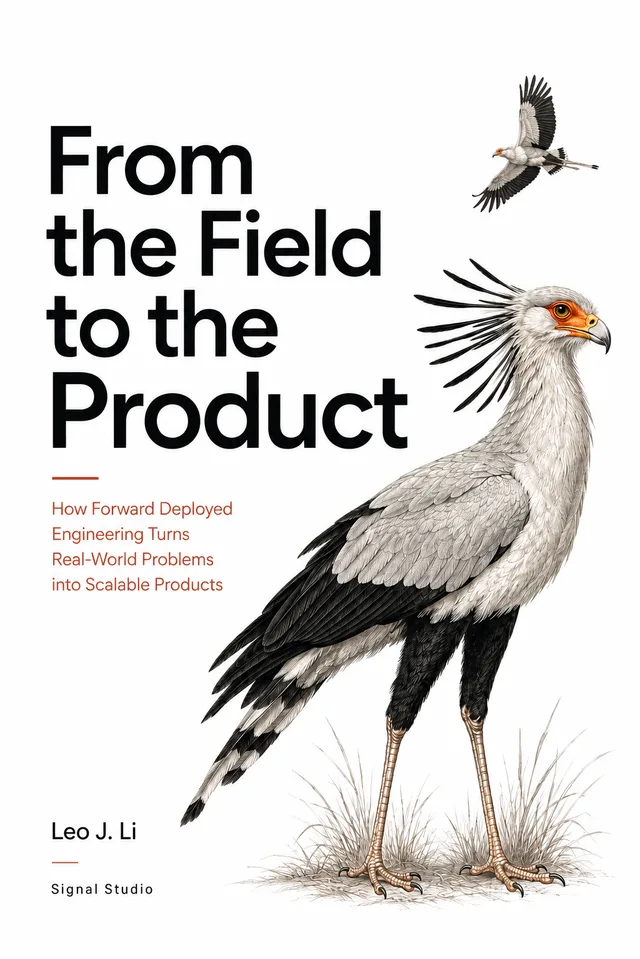
Signal Studio field guide
From the Field to the Product
How Forward Deployed Engineering Turns Real-World Problems into Scalable Products
A field guide to forward deployed engineering as an accountable loop from operational problems to production outcomes, reusable products, and customer independence.
For: FDE leaders, product engineering managers, enterprise AI delivery teams
What this book helps you do
This book defines forward deployed engineering by its operating loop, not its job title. Teams work close to a consequential problem, own production outcomes, convert local discoveries into reusable product capability, and transfer durable ownership. The guide also exposes the incentives and missing exit criteria that turn FDE into permanent custom development.
Problems this book helps you solve
- The team ships customer-specific code but cannot name what the core product learned.
- Success means delivery activity rather than a measurable operational outcome.
- Every deployment depends on the same embedded engineers indefinitely.
- Exceptions, scripts, and workarounds are invisible to product and platform owners.
- Customer adoption, operations, and ownership transfer are treated as post-launch support.
- FDE capacity grows with each account because reusable patterns are never extracted.
Start with a practical question
Use a focused guide for the immediate problem, then return here when you need the complete operating method.
- What is a forward-deployed engineer, really?
- How does an FDE differ from solutions, consulting, and implementation roles?
- How should an FDE team choose which customer problems to accept?
- When should an FDE project become a product feature?
- How do forward-deployed teams avoid permanent custom development?
- Which metrics show adoption, productization, and a healthy FDE exit?
- How should an AI company govern FDE access to customer data and production?
Decisions you will be able to make
- Whether a role or team is truly performing forward deployed engineering.
- Which problem merits field proximity and production ownership.
- What must be standardized, configured, extended, or deliberately kept local.
- When an exception should become a product capability, a supported extension, or retired work.
- Which exit criteria prove adoption, operability, ownership transfer, and product learning.
- How to measure field outcomes without rewarding permanent dependency.
Who this book is for
- Leaders designing an FDE function around product learning rather than consulting utilization.
- Engineers embedded with customers who need clearer boundaries, escalation paths, and exit criteria.
- Product teams deciding how field evidence enters roadmaps and reusable platform capability.
Who this book is not for
- Organizations using the FDE title as a rebrand for staff augmentation with no product feedback loop.
- Teams that promise unlimited customization without a supported ownership and maintenance model.
Reading path
- Define the operating loopDistinguish FDE from sales engineering, solution architecture, consulting, support, and core product work.
- Discover a consequential problemMap users, decisions, systems, constraints, evidence, and measurable operational outcomes.
- Build for productionOwn integration, reliability, security, change, and operational handoff rather than stopping at a demo.
- Drive adoptionMake workflow change, training, decision rights, and customer capability part of delivery.
- Productize the learningTurn repeated field patterns into governed product features, extension points, and playbooks.
- Scale the organizationDesign incentives, portfolios, rotations, knowledge flow, capacity limits, and exit criteria.
Field proximity must change the product
Embedding engineers near a difficult workflow is expensive. The model compounds only when field evidence becomes a supported product capability, clearer architecture, safer extension point, better operating practice, or an explicit decision not to generalize.
Independence is part of the outcome
A production launch is not complete when every change still requires the original FDE. Ownership transfer, operating competence, exit criteria, and a path for future product updates belong in the delivery contract.
Use it with
Review one active deployment. List its local exceptions, owners, product gaps, adoption risks, and exit criteria. Anything without a destination is accumulating as permanent custom work.
Evidence and method
The book separates public company descriptions and role evidence from author synthesis, composite cases, and recommended operating controls. Company examples establish how those organizations describe their model, not universal causality or guaranteed outcomes. The FDE boundary scorecards are explicit author frameworks intended for local review and adaptation.
Continue with the Kindle edition
Open the Amazon listing to review the current edition and use Read Sample or Kindle Instant Preview before deciding.
Read a sample
Signal Studio does not reproduce manuscript chapters on this site. Open the Amazon listing to use Read Sample or Kindle Instant Preview
Resources
The related guides contain original inline checklists and decision tables; no manuscript excerpt is republished.
Errata
Editorial QA: automated native-English, structure, metadata, and link checks completed . This record is not an independent expert endorsement. Review boundary.