
Question-led guide · definition
What is a forward-deployed engineer, really?
A decision-oriented definition of forward-deployed engineering, including ownership, customer proximity, product feedback, and boundaries with consulting.
Direct answer
A forward-deployed engineer is a product engineer who works close to a customer's real operating environment to turn an ambiguous, high-value workflow into reliable software—and then carries reusable learning back into the product. The role combines discovery, integration, implementation, production ownership, and product judgment. It is not defined by travel, ticket volume, or custom code. The decisive test is whether field work creates a durable customer outcome while reducing the cost of solving the next similar problem.
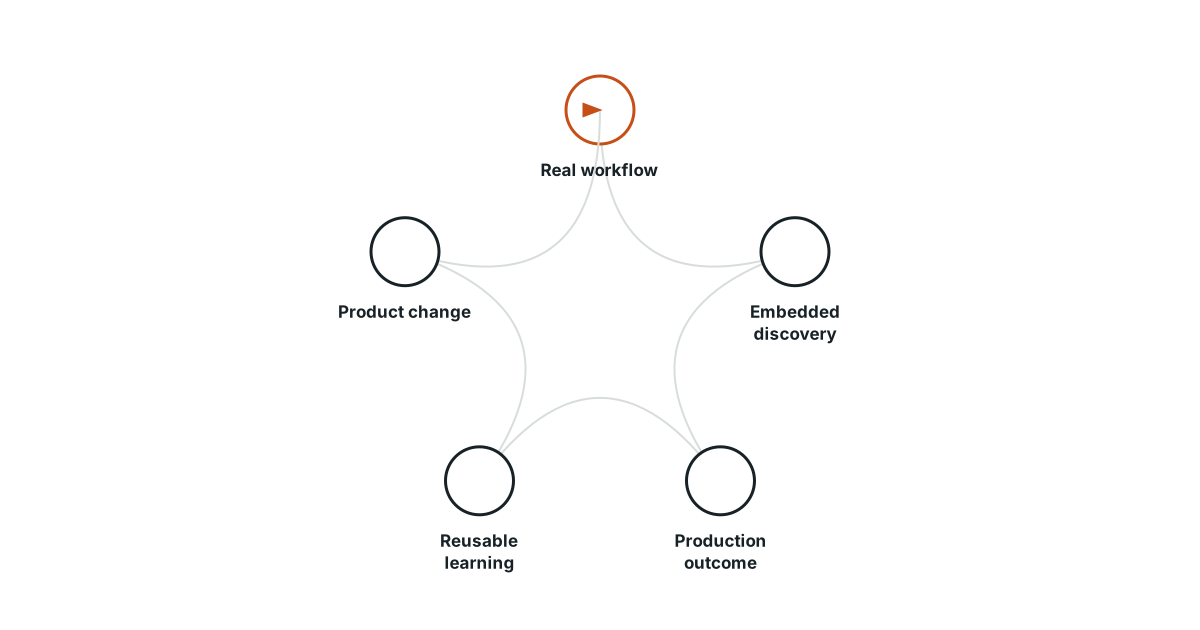
Define the role through its outputs
This definition is useful for enterprise software where customer environments, data, workflows, or organizational constraints make the path from product capability to realized value uncertain. It is less useful for routine onboarding that can be handled by documentation and standardized configuration.
The gap between product capability and operated value
A product can be technically capable yet fail to become operational inside a customer. Requirements are distributed across users, systems, policies, incentives, and legacy processes. A conventional handoff from sales to services to support loses context, while a pure product team may be too far from the environment to discover the real constraint.
The FDE role exists to compress this learning loop. The danger is that proximity to one customer turns into an endless custom-development queue.
A field discovery changes the core product
An FDE embeds with a logistics team to make one dispatch workflow reliable. The engagement ships the customer outcome and a reusable constraint engine that shortens the next three deployments.
Apply the dual-output test
Use five questions to decide whether work is genuinely forward-deployed engineering:
- Is the desired operational outcome important but incompletely specified?
- Does solving it require engineering inside real data, systems, and policy constraints?
- Will the engineer own the path to production behavior, not just a demo or recommendation?
- Is there a mechanism to convert field discoveries into product, platform, documentation, or repeatable implementation changes?
- Can the team decline work that creates no durable outcome or reusable learning?
If the answer to the fourth and fifth questions is no, the organization may have created a custom software service under a product title.
Close the field-to-product loop
Give the engagement a dual charter. The customer charter names one measurable workflow outcome, responsible users, constraints, production boundary, and acceptance test. The product charter names the assumptions being tested and the reusable assets expected from the work.
Keep FDEs connected to product engineering through shared repositories, design reviews, incident reviews, and a regular field-learning forum. Define decision rights for one-off configuration, product changes, customer-specific extensions, and rejected requests.
Measure time to first durable outcome, production adoption, reliability, and learning transfer. Also measure whether the next similar deployment becomes faster and less bespoke. Revenue and customer satisfaction matter, but they cannot reveal whether the operating model is accumulating product leverage or custom debt.
Customer-outcome and product-leverage scorecard
Score every engagement on two axes from 0 to 3:
| Axis | 0 | 1 | 2 | 3 |
|---|---|---|---|---|
| Customer outcome | No production change | Demo or manual workaround | Limited production use | Measured durable workflow outcome |
| Product leverage | No reusable learning | Undocumented insight | Reusable pattern or backlog decision | Shipped capability that reduces future effort |
An engagement with a high customer score and zero product leverage needs an explicit exception, owner, and exit plan. A high product score with no customer outcome may be research, not successful field deployment.
Definitions that turn FDE into generic custom engineering
- Defining the role by travel, urgency, or access to executive customers.
- Using FDEs as an unlimited integration backlog outside normal engineering controls.
- Measuring only contract value, utilization, or tickets closed.
- Keeping field code and incidents invisible to product engineering.
- Promising productization without a decision owner or adoption evidence.
- Confusing a compelling prototype with an operated customer workflow.
Evidence
Forward-deployed work includes direct customer collaboration and responsibility for production workflows.
Palantir's first-party role description emphasizes working directly with customers, understanding their problems, and building solutions in production contexts.
Primary source · official-doc · checked Aug 25, 2026
Limit: One company's job description reflects its operating model and is not a universal definition for every organization.
A forward-deployed function can emerge as a bridge between embedded customer work and a reusable product.
PagerDuty Engineering describes the evolution of a forward-deployed engineering practice and its relationship to customer needs and broader product use.
Primary source · official-doc · checked Aug 25, 2026
Limit: The account is a company-specific retrospective rather than comparative evidence about every FDE organization.
A healthy FDE engagement must produce both a customer outcome and a reusable product-learning asset.
The Signal Studio dual-output test evaluates each engagement on deployed outcome and transferable product leverage.
Signal Studio author framework · reviewed Aug 25, 2026
Limit: This is an author-created management framework and should be adapted to product maturity and customer commitments.
Limitations
Role names vary widely. This guide defines an operating model, not a claim that every employer uses the title consistently or that FDE is the right structure for every product.
FAQ
- Is an FDE just a solutions engineer who codes?
- Not necessarily. Titles overlap, but an FDE typically owns deeper implementation and production feedback while remaining accountable to the reusable product rather than only pre-sales progress.
- Should FDEs report to sales or engineering?
- Either can work if incentives protect technical quality, product learning, and honest scope decisions. Reporting lines matter less than explicit decision rights and success measures.
Related guides
Continue within Forward deployed engineering, or use one of these adjacent diagnostics:
Editorial QA: automated native-English, structure, source-presence, and link checks completed . This record is not an independent expert endorsement. Review boundary.