
Question-led guide · security
How do I check that signed-in users can access only their own records?
A beginner-friendly ownership check for personal cloud apps, separating sign-in from record authorization and testing two accounts with invented data.
Direct answer
Sign-in establishes who is asking; a separate server-side check decides which records that person may read or change. Test with two practice accounts and distinct records. Confirm that one account cannot read, edit, or delete the other’s record by changing a request identifier. Hiding a button in the browser is not an access rule.
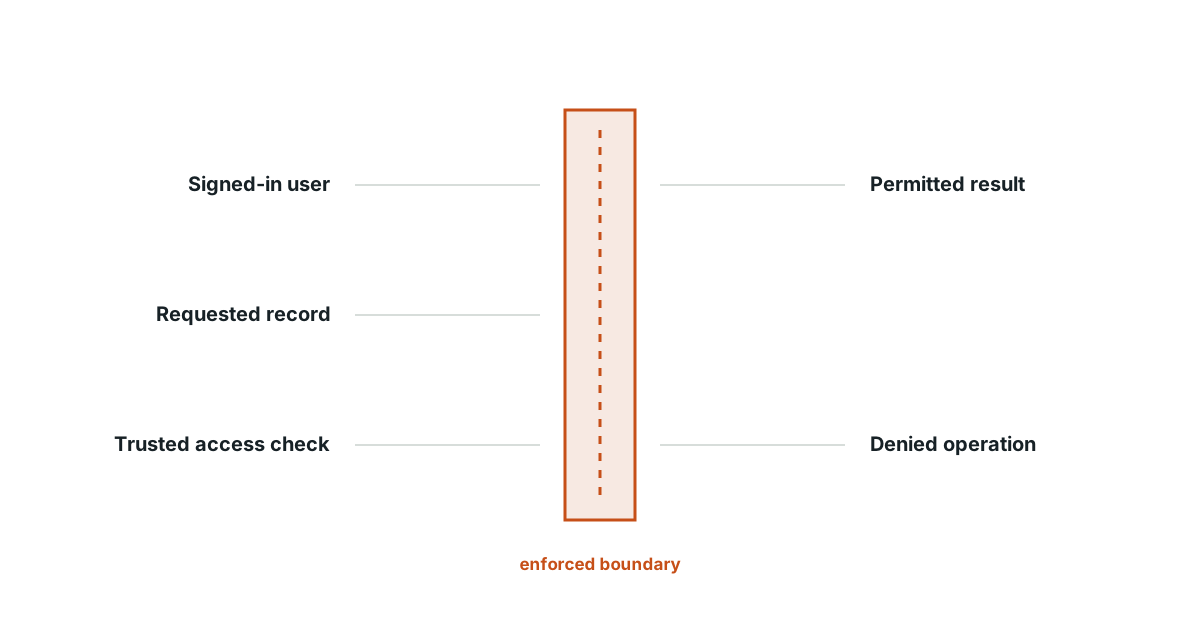
Separate entering the app from owning a record
A sign-in screen can work perfectly while private entries remain accessible to the wrong person. Authentication answers who is making the request. Authorization answers whether that person may perform this operation on this record. Keep those two questions separate when asking AI to add cloud storage to a personal app.
Give each private entry a trustworthy owner
In a fictional collection app, the server creates a record under the authenticated user’s identity. It should not simply accept an arbitrary owner supplied by the browser. On a later read or edit, the server checks the relationship again. An entry identifier helps locate a record; knowing the identifier should not by itself grant permission to use it.
Prepare two accounts with invented information
Use a development environment you control. Create one practice account named Cedar and another named Finch, with different sample entries. Keep separate browser profiles or sessions so that switching accounts is unambiguous. This is a test of your own application with your own data, not an invitation to probe someone else’s service.
Check every supported record action
| Attempt | Intended result for a private collection |
|---|---|
| Cedar reads Cedar’s entry | Allowed |
| Cedar updates Cedar’s entry | Allowed |
| Finch requests Cedar’s entry | Denied without exposing its contents |
| Finch updates Cedar’s entry | Denied with the original unchanged |
| Finch deletes Cedar’s entry | Denied with the original preserved |
| Signed-out request for a private entry | Denied |
Use the application’s test tools or ask the assistant to help exercise these cases safely. You should understand the requested operation and inspect both the response and the stored result.
Check the data after a denied change
A message saying “not allowed” is insufficient if the entry changed anyway. After the attempted edit or deletion, return as the rightful owner and verify that the original record remains intact. Also check that a denied read does not reveal the private note in an error message. This makes the outcome observable beyond the appearance of the interface.
Keep public sharing a separate feature
If the app later supports public entries, define that choice explicitly. Test the private default, deliberate sharing, and any supported revocation behavior separately from ownership. A browser filter or hidden button can help the interface, but the trusted service must enforce the rule. Before allowing real users to store important information, review the complete access design with someone able to assess the server and its deployment.
Evidence and scope
- OWASP Authorization Cheat Sheet: Authorization must be checked on every request and enforced in a trusted component.
- MDN Client-server overview: Client-server applications exchange requests and responses, with server-side code processing requests.
The proposed checks are teaching tools; validate their behavior in the actual environment.
Evidence
Authorization must be checked on every request and enforced in a trusted component.
Authorization must be checked on every request and enforced in a trusted component.
Primary source · official-doc · checked Sep 11, 2026
Limit: This source supports the named mechanism, not the outcome or thresholds of the illustrative workflow.
Client-server applications exchange requests and responses, with server-side code processing requests.
Client-server applications exchange requests and responses, with server-side code processing requests.
Primary source · official-doc · checked Sep 11, 2026
Limit: This source supports the named mechanism, not the outcome or thresholds of the illustrative workflow.
Limitations
The scenarios and decision worksheets are original teaching examples. They are not measured deployments or guarantees; adapt the checks to the actual system and its documented behavior.
FAQ
- Is a hard-to-guess record ID enough protection?
- No. The trusted service still needs to check whether the current user may access that specific record.
- Why inspect the stored record after a denied request?
- It confirms that the operation had no unauthorized effect, rather than merely displaying a denial message.
Related guides
Continue within Build your first app with AI, or use one of these adjacent diagnostics:
Editorial QA: automated native-English, structure, source-presence, and link checks completed . This record is not an independent expert endorsement. Review boundary.