
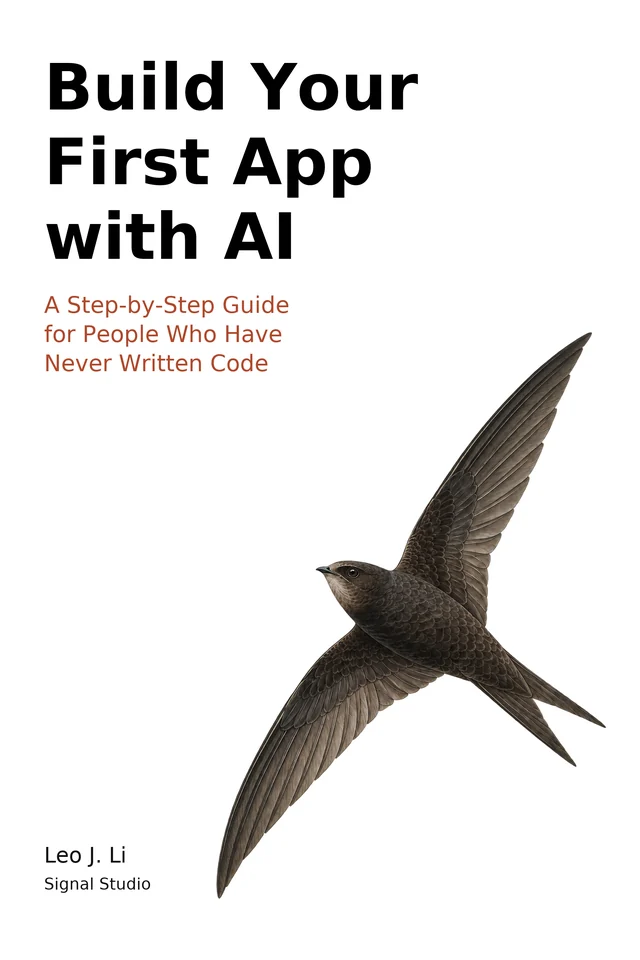
Signal Studio field guide
Build Your First App with AI
A Step-by-Step Guide for People Who Have Never Written Code
A beginner path from a first web page to an AI-built app, with recoverable data, checkable changes, and deliberate release decisions.
For: People who have never written code, Independent creators building a first personal tool, Learners who want to understand and maintain an AI-assisted app
What this book helps you do
Build a small app around content you understand, then learn the next concept when the project needs it. This book follows one collection from a readable page through editing and storage to an optional cloud version. AI helps make and explain changes while the reader learns to inspect behavior, preserve work, recover from mistakes, and decide what to publish.
Problems this book helps you solve
- AI produced an impressive page, but you do not know which file controls it.
- A request adds many features while the original behavior becomes harder to check.
- A button looks correct but fails on an empty or repeated submission.
- Saved entries disappear in another browser or after a storage failure.
- An error leads to repeated rewrites instead of a clear explanation.
- Sign-in works, but record ownership has not been tested.
- You have a preview link without a clear audience or recovery plan.
Start with a practical question
Use a focused guide for the immediate problem, then return here when you need the complete operating method.
- What is a good first app to build with AI if I have never coded?
- How do I ask AI for a code change I can actually check?
- How can I check buttons, forms, and empty states in my first app?
- Is browser storage enough to keep the data in my first app safe?
- How do I debug an AI-built page when I do not understand the code yet?
- How do I check that signed-in users can access only their own records?
- What should I review before putting my first AI-built app online?
Decisions you will be able to make
- Which small first project you can judge and explain.
- How to ask for one visible change and inspect the files involved.
- What buttons, forms, layout, and empty states should do.
- Where collection data lives and how an export can restore it.
- How to turn a broken behavior into a reproducible debugging question.
- When components, tests, a service, or cloud accounts solve a real need.
- Which version, audience, and data boundary you choose before publishing.
Who this book is for
- First-time builders who want a progressive project they can keep changing.
- Readers willing to try small edits and checks rather than only accept generated output.
Who this book is not for
- Experienced developers seeking an advanced framework reference.
- Readers expecting one prompt to remove every need for review, debugging, or operating responsibility.
Reading path
- Chapters 1–5: Start and make a first changeSet up a workbench, build a first page, clarify a request, and read the code that matters.
- Chapters 6–11: Make the page usable and recoverableDevelop structure, visual rules, responsive layout, form behavior, skill judgment, and saved versions.
- Chapters 12–16: Build a local collectionFollow a click, edit records, save and restore data, debug with evidence, and review a first page for hosting.
- Chapters 17–23: Keep the project understandableLearn project tools, components, types, written intent, reusable skills, and checks that can stop mistakes.
- Chapters 24–28: Add an optional cloud boundaryConnect a service, assign owners to records, test access after sign-in, and practice recovery.
- Chapters 29–32 and appendices: Release and continuePlan a trial, retain the publication decision, learn from real attempts, and make the next change yourself.
Start with a result you can recognize
A reading collection, recipe showcase, or page of familiar places gives you content you can judge. The early chapters keep the first version small: organize the page, find the relevant file, change something visible, and check the result. Editing, persistence, and accounts arrive as new responsibilities when they serve the project.
Keep AI useful while understanding grows
The reader can ask AI to propose code, explain a selected region, suggest checks, or help isolate a fault. The browser and saved files establish what happened. The book repeatedly returns to that connection so that a successful generated artifact becomes something the reader can maintain rather than an object they cannot safely change.
Choose how far the project needs to go
A readable showcase or a local collection can be a useful finished project. The later cloud chapters are an extension for readers who need stored accounts and services. They introduce ownership and access checks before treating sign-in as a complete privacy boundary.
Edition information
Build Your First App with AI is the current English second edition of the book previously published as AI Programming from Zero. The Kindle link on this page opens the current edition. Readers already writing software can continue with Engineering Judgment in the Age of AI for a complementary focus on technical tradeoffs.
Evidence and method
The English second edition uses one progressive collection project, original practice examples, official web documentation, and a versioned companion. Its exercises teach observable behavior and bounded checks. They do not promise that generated code is correct or that a small learning application is suitable for sensitive or high-consequence production use.
Continue with the Kindle edition
Open the Amazon listing to review the current edition and use Read Sample or Kindle Instant Preview before deciding.
Read a sample
Signal Studio does not reproduce manuscript chapters on this site. Open the Amazon listing to use Read Sample or Kindle Instant Preview
Resources
The related guides contain original inline checklists and decision tables; no manuscript excerpt is republished.
Errata
Editorial QA: automated native-English, structure, metadata, and link checks completed . This record is not an independent expert endorsement. Review boundary.