
Question-led guide · comparison
How should I choose RDF, OWL, SHACL, a property graph, or a relational model?
A modeling-stack decision that separates data model, vocabulary, inference, validation, query, storage, interoperability, operations, and team capability.
Direct answer
Choose a stack by capability, not by one winning label. RDF gives a graph data model and global identifiers; OWL adds formal ontology semantics and inference; SHACL validates RDF graphs; property graphs optimize a different node-edge-property model and traversal ecosystem; relational systems provide mature tabular constraints and transactions. Many operational systems use a hybrid. Separate conceptual model from storage, then test real queries, updates, constraints, scale, interoperability, and team operations.
Start with the semantic job
Use this guide when designing an ontology, semantic layer, knowledge graph, or operational metadata system and choosing its technical stack. It separates capabilities that are often collapsed. It does not rank vendors or require that one technology own every layer.
Why technology names hide different responsibilities
Teams compare RDF, OWL, SHACL, property graphs, and relational databases as interchangeable products. They are not the same kind of thing. RDF is a data model; OWL is an ontology language layered on RDF; SHACL is a validation language for RDF graphs. Property graphs define another modeling family, while relational systems combine a model with mature database implementations.
Marketing adds another confusion: “knowledge graph” can describe the application regardless of its storage. A conceptual ontology can inform schemas and APIs without being the sole physical database.
Configuration validation plus incident traversal
A relational store remains the transactional system of record, SHACL validates exported operational facts, and a property graph supports bounded traversal. OWL inference is added only for rules whose semantics and cost are understood.
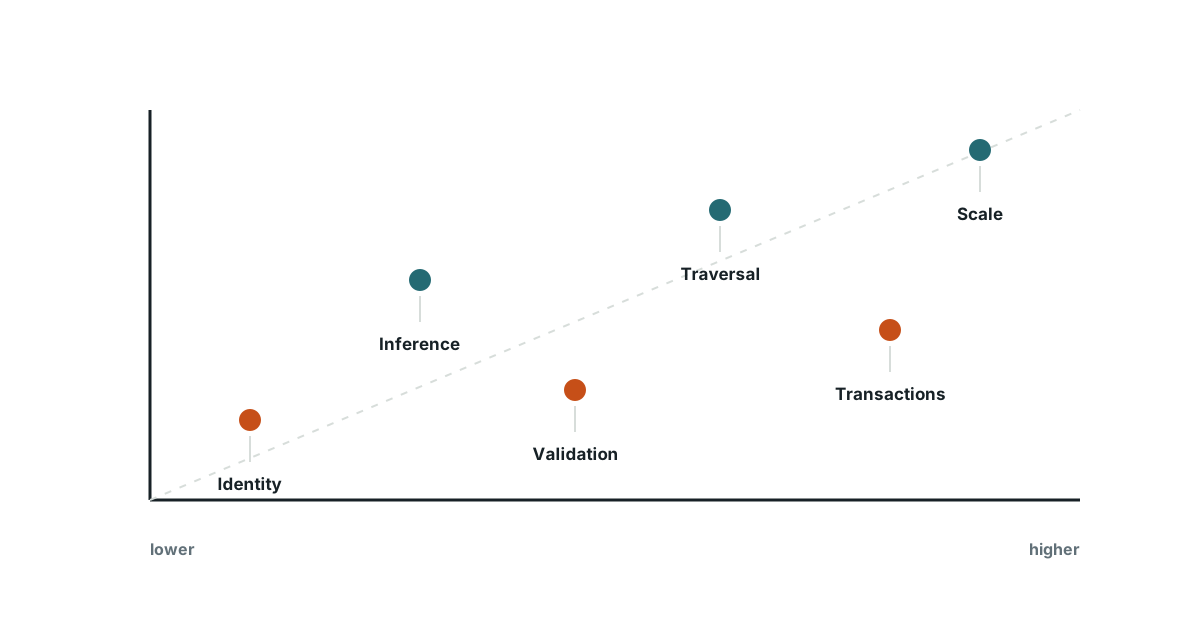
Test identity, inference, validation, traversal, and transactions
Write competency questions and operations before evaluating stacks. Include:
- identity and cross-source mapping;
- hierarchy and type reasoning;
- constraint validation and error reporting;
- path and neighborhood traversal;
- transactional updates and concurrency;
- temporal and provenance queries;
- interoperability and published vocabulary reuse;
- permissions, tenancy, audit, backup, and disaster recovery;
- latency, volume, update rate, and team support.
Prototype the hardest read and write paths. A beautiful ontology that cannot support required updates or access policy is not an operational design.
Compose a stack with explicit boundaries
Choose the minimum semantic commitment that answers the questions. RDF plus a vocabulary may be enough for interoperable identifiers and graphs. Add OWL profiles when formal entailment is required and tested. Add SHACL for explicit RDF data constraints and validation reports. Consider a property graph for traversal-heavy applications with its ecosystem, or relational storage for transaction-heavy structured operations.
Use hybrid designs deliberately: a relational system of record, event/change stream, graph read model, and ontology/vocabulary registry can coexist. Define source of truth, synchronization, consistency, mapping, and failure behavior. Avoid duplicating authority across stores.
Modeling-stack decision table
Score candidate stacks against this table:
| Need | Required semantics/behavior | Candidate layer | Test artifact | Operational owner |
|---|---|---|---|---|
| Global identity/interchange | IRIs, mappings, shared vocabulary | RDF/vocabulary | Round-trip mapping | |
| Formal inference | Entailments and bounded profile | OWL/reasoner | Competency-query tests | |
| RDF validation | Shapes, severity, reports | SHACL | Positive/negative graph suite | |
| Traversal | Paths, neighborhoods, graph algorithms | Property/RDF graph | Workload benchmark | |
| Transactions | Constraints, updates, isolation | Relational/graph DB | Concurrent update test | |
| Time/provenance | Versioned events and lineage | Model + storage | Historical query pack | |
| Security/operations | Tenant policy, audit, backup, recovery | Platform | Failure and restore drill | |
| Team fit | Skills, tooling, debugging, on-call | Organization | Support exercise |
Selections made from graph aesthetics
- Comparing an ontology language directly with a database product.
- Adding OWL because the project uses the word ontology, without required entailments.
- Assuming OWL’s open-world semantics performs closed-world data validation.
- Choosing graph storage before writing real updates and permission queries.
- Building a hybrid without clear source-of-truth and synchronization failure rules.
Evidence
RDF 1.1 defines a graph-based data model using IRIs, literals, blank nodes, triples, and RDF datasets.
The W3C Recommendation specifies RDF's abstract syntax and core data-model concepts.
Primary source · standard · checked Aug 26, 2026
Limit: The abstract data model does not choose a database implementation, validation strategy, or operating architecture.
OWL 2 is a family of ontology-language specifications with formal semantics and profiles for different expressivity and computational needs.
The W3C OWL 2 overview maps the language's specification documents, profiles, syntax, semantics, and use.
Primary source · standard · checked Aug 26, 2026
Limit: OWL expressivity and reasoning do not replace data validation, source quality, security, or operational ownership.
SHACL defines shapes and constraints for validating RDF data graphs and reporting validation results.
The W3C Recommendation specifies SHACL Core and SPARQL-based constraint components and validation reports.
Primary source · standard · checked Aug 26, 2026
Limit: SHACL validation checks declared constraints; it does not prove all domain truths or make an ontology useful.
The stack decision should be evaluated as a combination of model, semantics, constraints, query, storage, and operations.
The decision table below prevents direct comparison of technologies that solve different layers.
Signal Studio author framework · reviewed Aug 26, 2026
Limit: Product implementations vary widely; benchmark the exact versions and deployment model under realistic workloads.
Limitations
This comparison is conceptual and omits many products, graph query languages, reasoners, and distributed architectures. Performance and maintainability depend on data shape, query mix, inference, update rate, tooling, team experience, and implementation quality.
FAQ
- Does using RDF require OWL?
- No. RDF can be used with lightweight vocabularies, RDFS, SHACL, application logic, or other layers. Add OWL only when its semantics and inference support required competency questions.
- Can a relational database store an ontology-backed application?
- Yes. The conceptual and API model can be ontology-informed while operational data uses relational storage. Document semantic mappings and validate that required queries and constraints survive translation.
Related guides
Continue within Ontology and operational semantics, or use one of these adjacent diagnostics:
Editorial QA: automated native-English, structure, source-presence, and link checks completed . This record is not an independent expert endorsement. Review boundary.