
Signal Studio field guide
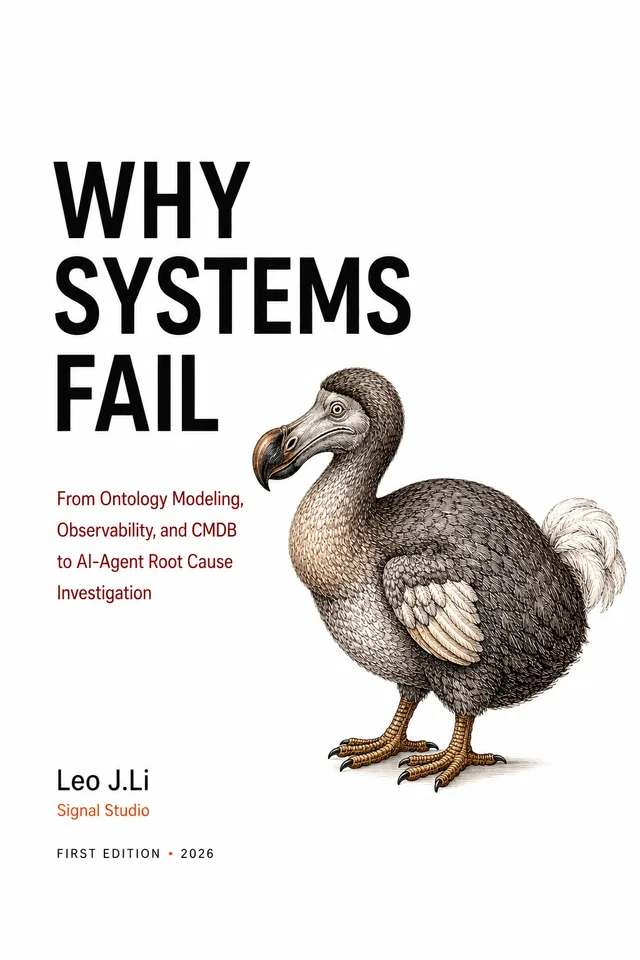
Why Systems Fail
From Ontology Modeling, Observability, and CMDB to AI-Agent Root Cause Investigation
A systems guide to building operational semantics across ontology, CMDB, telemetry, provenance, topology, change, and AI-assisted root cause investigation.
For: data and ontology architects, configuration management teams, observability and SRE engineers
What this book helps you do
This book explains why operational systems disagree even when every database has an owner. It connects identity, classes, relationships, time, provenance, constraints, change, telemetry, CMDB, and knowledge graphs so engineers can distinguish declared topology from observed behavior and give AI investigators bounded, queryable evidence instead of ambiguous labels.
Problems this book helps you solve
- The same service, component, resource, or application has several incompatible identifiers.
- A CMDB record is complete but stale, duplicated, orphaned, or mapped to the wrong runtime entity.
- Taxonomy, ontology, knowledge graph, semantic layer, and catalog are treated as synonyms.
- Declared dependencies are mistaken for evidence that a runtime request used that path.
- Telemetry and configuration data cannot be joined with stated provenance and time.
- An AI investigator receives a graph but cannot tell which edges are asserted, inferred, observed, or outdated.
Start with a practical question
Use a focused guide for the immediate problem, then return here when you need the complete operating method.
- Ontology, taxonomy, knowledge graph, or semantic layer: which one do you need?
- Why does CMDB data become stale even after a cleanup?
- How can traces, metrics, logs, changes, and services share stable identity?
- How can an ontology support RCA without claiming causality?
- How should I choose RDF, OWL, SHACL, a property graph, or a relational model?
- How should I model incidents, changes, deployments, and dependencies over time?
- How do I validate an ontology before an AI agent relies on it?
Decisions you will be able to make
- Whether a problem needs labels, a taxonomy, an ontology, a graph, a semantic layer, or a combination.
- How identity, equivalence, versioning, and source records map to operational entities.
- Which constraints belong in an ontology, validation layer, application, or governance process.
- How to represent events, state, time, provenance, confidence, and conflicting observations.
- How CMDB, discovery, service catalogs, telemetry resources, and topology evidence should interact.
- Which graph paths support impact analysis or causal candidates without proving causality.
Who this book is for
- Architects reconciling CMDB, catalogs, telemetry, and operational data for investigation or automation.
- Teams deciding among semantic technologies based on required commitments and operating duties.
- AI and SRE teams that need traceable entity and relationship evidence for root-cause analysis.
Who this book is not for
- Readers looking for a single vendor product to eliminate semantic governance and source conflict.
- Projects that need only a small local schema and have no cross-system identity or lifecycle problem.
Reading path
- Clarify the semantic choicesDistinguish inventories, taxonomies, ontologies, graphs, semantic layers, and operational models.
- Model identity and relationshipsDefine entities, keys, equivalence, roles, composition, events, state, time, and provenance.
- Use formal standards deliberatelyUnderstand what RDF, RDFS, OWL, SPARQL, SKOS, and SHACL add—and what they do not.
- Repair the CMDB boundarySeparate source records, domain entities, observations, lifecycle, reconciliation, and ownership.
- Connect telemetry and topologyRelate declared structure, runtime resources, observed paths, changes, incidents, and evidence windows.
- Bound AI investigationRetrieve relevant subgraphs while preserving source, time, confidence, permissions, and causal limits.
Ownership does not create operational truth
A named owner can improve accountability, but freshness still depends on identity, update paths, discovery coverage, lifecycle rules, source precedence, and the time represented by each observation. Semantic quality is an operating system, not a documentation field.
Graphs contain different kinds of edges
A declared dependency, an observed network call, an inferred relationship, and a human assertion carry different evidentiary weight. The book keeps those distinctions visible so impact analysis does not silently become a causal claim.
Use it with
Take one incident and trace a single affected entity across its catalog, CMDB, deployment, telemetry resource, runtime path, change record, and owner. Record every identity conversion and the time each source actually describes.
Evidence and method
W3C standards and official product documentation establish their own data models and behaviors; the cross-system operational model is an author synthesis. Product examples show documented capabilities, not endorsements or equivalence. Synthetic cases distinguish declared, observed, inferred, and disputed relationships and never treat graph connectivity as proof of root cause.
Continue with the Kindle edition
Open the Amazon listing to review the current edition and use Read Sample or Kindle Instant Preview before deciding.
Read a sample
Signal Studio does not reproduce manuscript chapters on this site. Open the Amazon listing to use Read Sample or Kindle Instant Preview
Resources
The related guides contain original inline checklists and decision tables; no manuscript excerpt is republished.
Errata
Editorial QA: automated native-English, structure, metadata, and link checks completed . This record is not an independent expert endorsement. Review boundary.