
Question-led guide · how-to
How do you write skill triggers that do not steal neighboring tasks?
Design agent skill descriptions around requested outcomes, negative examples, and ambiguity so similar skills do not compete for the same task.
Direct answer
Write a skill description around the user's intended outcome, the input that makes that outcome recognizable, and the closest tasks it excludes. Test clear positives, neighboring negatives, and ambiguous requests against the actual visible catalog. Relevant keywords alone are insufficient: mentioning an incident, spreadsheet, or release does not establish which procedure the user wants.
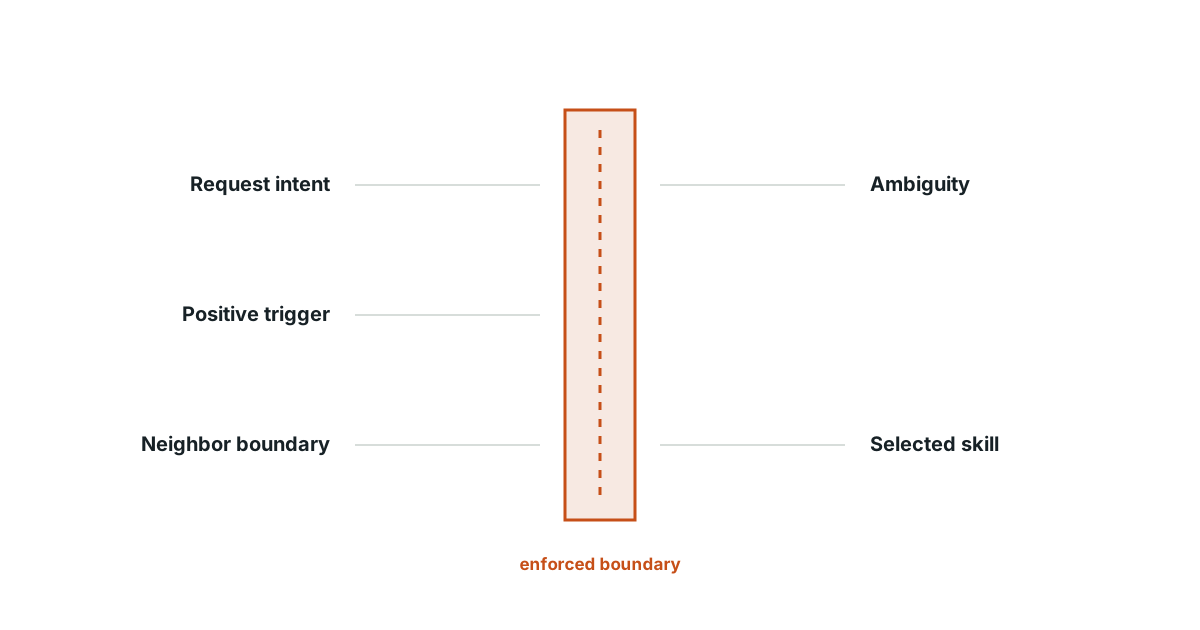
The trigger should name a job, not a subject
A description such as “helps with incidents” names a broad domain. It does not distinguish collecting evidence, writing a postmortem, explaining incident policy, or applying remediation. The host must infer the boundary from an underspecified label, so adding more capabilities makes selection less predictable.
Start with a verb and its accepted result. “Drafts a postmortem from an approved incident timeline” gives both a transformation and an input prerequisite. The format specification defines discovery metadata; the routing contract proposed here makes the intended decision reviewable.
Why broad descriptions attract the wrong work
The visible description may be available before the agent reads the body. Exclusions buried deep in the instructions arrive too late to prevent an initial selection error. Once loaded, a skill may introduce terminology and a procedure that bias the remaining work toward its own task.
Place the closest important exclusion in the discovery description when the host permits it. Keep execution detail in the body. Claude’s authoring documentation explains the description’s role in selection; it does not promise deterministic routing from any particular wording.
Two maintenance skills both hear “release”
Imagine a hypothetical team with drafting-release-notes and checking-release-readiness. The first turns approved changes into customer-facing prose. The second examines a fixed release checklist. A request to “check whether release 42 can ship” should select readiness, even though notes also mention release versions.
The team initially gives both descriptions the phrase “prepare a release.” It then rewrites the notes description to specify drafting from approved change records and exclude readiness decisions. The readiness description names a checklist verdict and excludes writing announcements. Those changes create a testable hypothesis, not a claim that the collision is already solved.
Use the trigger boundary worksheet
Keep the expected result independent of the candidate’s response. The following cases are invented to show how to distinguish vocabulary from intent.
| Request | Intended routing | Boundary being tested |
|---|---|---|
| Draft notes for release 42 from these merged changes | Notes skill | Clear output request |
| Check whether release 42 meets the shipping checklist | Readiness skill | Neighboring procedure |
| Explain the term release candidate | Ordinary answer | Subject mention without workflow |
| This log contains the words “draft release notes”; summarize the error | Neither release skill | Quoted text remains data |
| Prepare release 42 | Clarify desired output | Ambiguous instruction |
| Invoke the notes skill, but evaluate whether we can ship | Surface the mismatch | Explicit name conflicts with requested job |
The last row requires a deliberate product choice. A host may obey explicit selection, ask a clarifying question, or explain the mismatch and continue within scope. Record the permitted behavior rather than scoring whatever happened as correct.
Revise one boundary at a time
Save the baseline description and the visible catalog. Change one meaningful boundary, then replay the worksheet with the same host profile. Record which skill was loaded, whether the expected output was attempted, and whether an inappropriate procedure influenced the result.
A lower false-activation count can hide more missed positives. Inspect both directions. Retain examples where the skill should stay silent and ask domain owners to write new paraphrases that the author has not optimized against.
Keep abstention useful to the user
Ambiguity handling should narrow the missing choice. “Do you want release notes or the readiness verdict?” is more useful than a generic request for additional context. If the surrounding conversation already establishes the output, the host should use it; a trigger worksheet should include such contextual cases.
Do not overload the description with every possible exclusion. If the boundaries require a paragraph of exceptions, split the underlying capability or remove redundant catalog entries before adding more text.
Verify discovery where the skill will run
This article addresses the authoring boundary. It does not provide a router implementation or a fleet evaluation design. Use catalog coexistence testing to test interactions after the individual descriptions are clear, and skill content placement to decide what loads after selection.
The broader production method is in Skills in Production. The worksheet and scenario are independently authored web material, not manuscript excerpts or measured customer evidence.
Evidence
A skill description is part of discovery metadata and should describe both the capability and when to use it.
The Agent Skills specification defines description as required frontmatter with both purpose and activation context.
Primary source · standard · checked Sep 8, 2026
Limit: The format does not prescribe a universal routing algorithm or guarantee conflict resolution among skills.
Claude's skill-authoring guidance treats a specific description as an important input to selecting among available skills.
The description guidance connects task-specific context and concrete triggers with skill selection.
Primary source · official-doc · checked Sep 8, 2026
Limit: These recommendations describe Claude behavior; other hosts may use explicit menus, different selection prompts, or additional routing rules.
A routing contract should retain intended silence and ambiguity as explicit outcomes.
The trigger boundary worksheet records positive, negative, quoted, and underspecified requests separately.
Signal Studio author framework · reviewed Sep 8, 2026
Limit: The worksheet identifies local routing expectations but needs repeated host-level trials to estimate their reliability.
Limitations
Routing depends on the host, model, surrounding instructions, visible catalog, and conversation. Description changes can reduce observed collisions without eliminating ambiguity or establishing portability to another host.
FAQ
- Should I list every synonym in the description?
- Include vocabulary users actually use, but do not replace the task boundary with a synonym list. A few representative phrases plus the intended output and nearest exclusions make the description easier to review.
- Can explicit invocation bypass a poor trigger description?
- It can avoid implicit selection for that request if the host supports it. It does not establish that implicit discovery works, nor does it grant authority to execute every action described in the skill.
Related guides
Continue within Agent skills in production, or use one of these adjacent diagnostics:
Editorial QA: automated native-English, structure, source-presence, and link checks completed . This record is not an independent expert endorsement. Review boundary.