
Question-led guide · comparison
When should a workflow become an agent skill?
Decide whether recurring work needs a reusable agent skill, a prompt, a deterministic program, or a tool by writing the capability contract first.
Direct answer
Package work as an agent skill when a recurring task needs reusable procedural judgment, a recognizable activation boundary, and an owned result contract. Keep exact transformations in code and external operations behind tools. A one-off instruction may remain a prompt. Before creating the folder, specify supported inputs, accepted outputs, exclusions, dependencies, and the person responsible for keeping the capability correct.
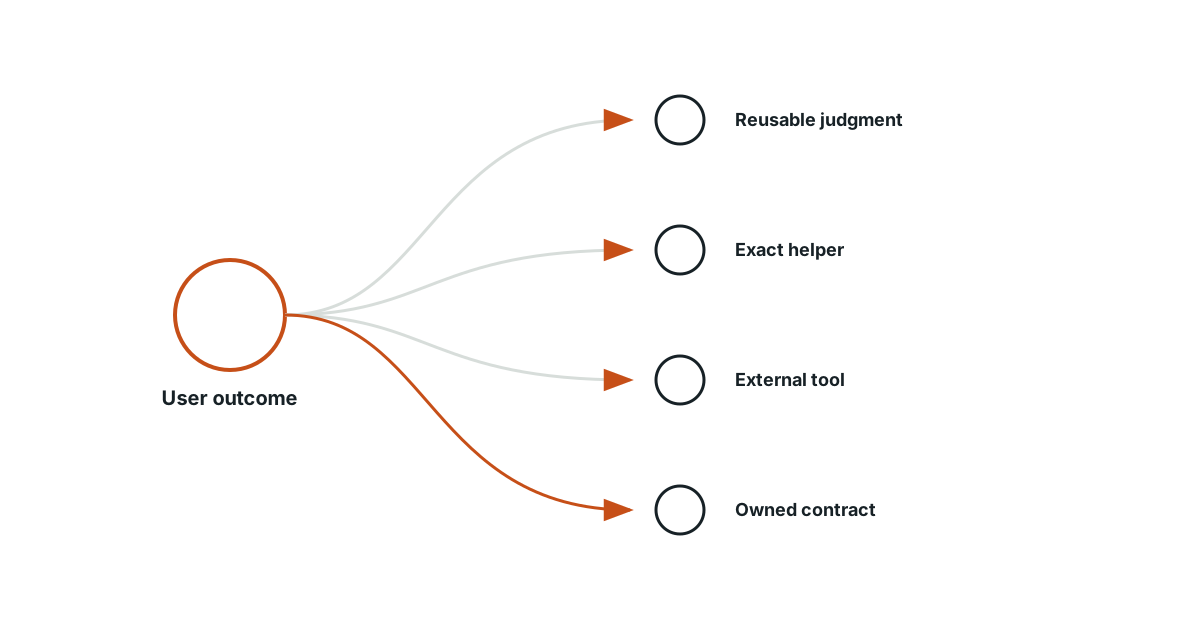
Repetition is useful evidence, but not the decision
A team may repeat a task hundreds of times and still need an ordinary program. Another task may occur monthly yet require enough specialized judgment to justify a skill. Ask what stays stable across executions: the exact transformation, the decision procedure, or only the desired outcome. Those answers point to different implementation objects.
The Agent Skills specification supplies a small package format. It does not require a fleet controller before an author can create a useful folder. The additional contract below becomes valuable when another person depends on the behavior and cannot reconstruct the author’s assumptions.
Locate the judgment that callers keep rediscovering
A prompt expresses the current request. A tool exposes a callable operation. A deterministic program carries a transformation whose rules can be implemented directly. A skill teaches the agent how to approach a recurring class of work, including choices that depend on the evidence found during execution.
The boundary matters because each object has a different failure owner. If a file parser drops rows, fix the parser. If the agent selects the wrong analysis for a valid file, inspect the skill. If a request can alter an unauthorized account, the enforcing tool or runtime needs attention. Rewriting prose cannot repair every layer.
A release-note assistant with three separate jobs
Consider a hypothetical product team preparing notes for six repositories every fortnight. Its assistant reads merged pull requests, groups changes by user impact, and drafts release notes. The recurring judgment is deciding whether a change is user-visible and explaining its consequence without copying internal implementation chatter.
Fetching pull requests belongs behind an authenticated tool. Sorting changes by merge time belongs in ordinary code. Editorial categorization and handling ambiguous changes belong in the skill. Publishing the approved notes remains a separate operation with its own owner and authorization. Packaging all four as an undifferentiated “release helper” makes it difficult to know which promise failed.
Fill the capability selection card
Use one row per proposed capability, not per directory. The example is constructed for this guide and is not a report of customer results.
| Field | Release-note drafting decision |
|---|---|
| Recurring judgment | Classify merged changes by user consequence |
| Required input | Repository scope, release interval, approved change records |
| Accepted output | Draft notes with links and explicit uncertain classifications |
| Exact helper work | Normalize identifiers and sort records |
| External operations | Read pull requests; publishing is excluded |
| Activation boundary | A request to draft notes for a specified release |
| Safe stop | Missing release interval or unavailable change evidence |
| Maintenance owner | Developer communications lead |
| Evidence before sharing | Representative accepted drafts and negative activation cases |
The card exposes a useful disagreement: perhaps the team does not agree on what counts as user-visible. Resolve that editorial contract before teaching a model to apply it. A package cannot manufacture a stable organizational decision.
Prefer code where exactness defines success
When success means producing the same checksum, validating the same schema, or applying a known conversion, implement that operation directly. The skill can decide when to invoke the helper and interpret its result. Anthropic’s engineering explanation illustrates this division between procedural guidance and executable work.
Give the helper a narrow interface and a clear failure result. A script that silently downloads dependencies, changes global configuration, and then generates a report has expanded the package’s operating surface. Its convenience does not remove those dependencies from review.
Share only the promise you can maintain
Before distributing the first version, run a normal request, a neighboring request that should not activate it, and a request with missing prerequisites. Check the resulting artifacts and the path taken. These probes are a starting point, not a statistical reliability claim.
If no owner can update references when the product changes or explain a disputed output, keep the capability experimental and limit who depends on it. Ownership can be lightweight; it must still be identifiable.
Bound the decision and continue with authoring
This guide does not design tool authorization or durable workflow recovery. It decides which reusable behavior deserves a skill boundary. For the next implementation choice, use trigger descriptions that preserve neighboring intent and the division between instructions, references, and scripts.
The complete lifecycle appears in Skills in Production. This web guide is independently written and does not reproduce a manuscript excerpt.
Evidence
The Agent Skills format requires a SKILL.md file and permits supporting scripts, references, and assets.
The specification defines the package's minimal structure and optional supporting material.
Primary source · standard · checked Sep 8, 2026
Limit: Format validity does not establish that the proposed capability is useful, supported, or correctly enforced by a host.
A skill can combine task instructions with executable helpers instead of asking the model to generate every transformation.
Anthropic describes packaged procedural knowledge and code execution as complementary parts of a skill.
Primary source · official-doc · checked Sep 8, 2026
Limit: This is a vendor-authored mechanism description, not independent evidence that every recurring workflow benefits from a skill.
A packaging decision should start with an observable capability promise and a named maintenance owner.
The capability selection card separates judgment, exact computation, external operations, and ownership.
Signal Studio author framework · reviewed Sep 8, 2026
Limit: The proposed decision method needs local examples and may reject useful small skills whose maintenance cost is negligible.
Limitations
The selection card is an architectural judgment aid. It does not measure adoption, prove return on investment, grant tool access, or establish compatibility across agent hosts.
FAQ
- Does a skill need a script to be worth packaging?
- No. Reusable decision guidance can justify a skill on its own. Include a script only when it performs a defined transformation or operation more reliably than repeated model-generated code.
- Should every team playbook become a skill?
- Only when the intended host can discover and apply a bounded part of the playbook, and someone can test and maintain that behavior. An unowned document copied into a folder has acquired a package format, not an operating contract.
Related guides
Continue within Agent skills in production, or use one of these adjacent diagnostics:
Editorial QA: automated native-English, structure, source-presence, and link checks completed . This record is not an independent expert endorsement. Review boundary.