
Question-led guide · governance
How should an AI company govern FDE access to customer data and production?
A customer-environment control checklist for least privilege, separation, temporary access, approvals, audit, data handling, reversibility, incidents, and handoff.
Direct answer
Govern FDE access as temporary, customer-authorized, task-bound privilege. Separate customer and vendor identities, environments, data classes, and duties; issue short-lived access to named resources and operations; bind approvals to change proposals; log reads and effects; protect local artifacts; and revoke at milestones and exit. The customer retains authority over production, and emergency access needs an independent, tested process.
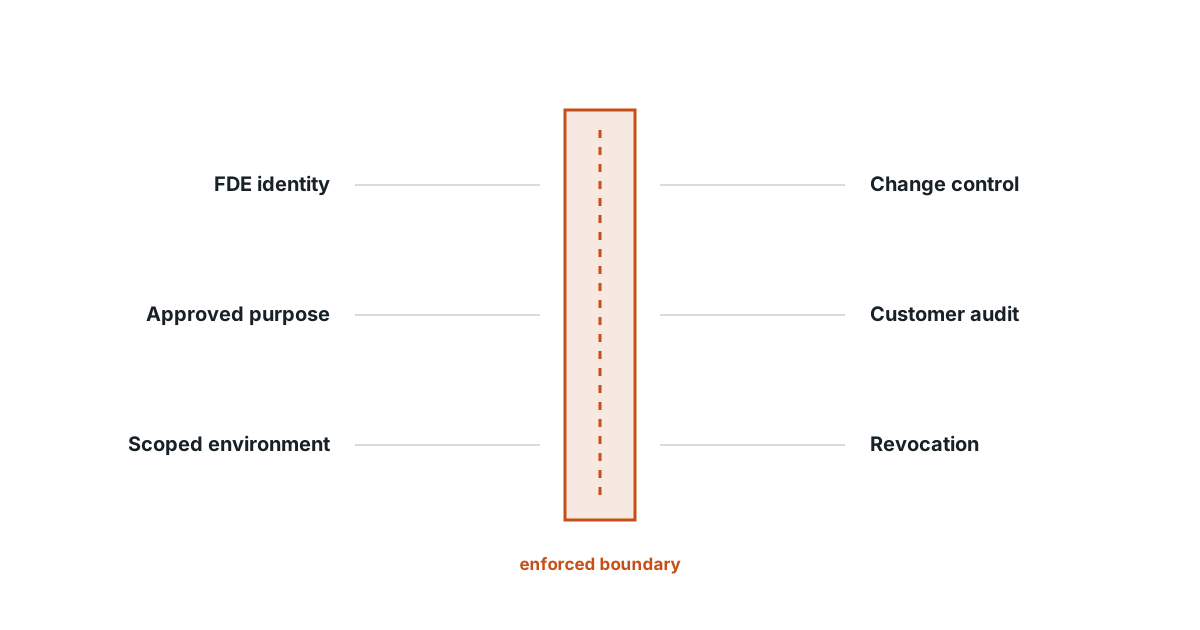
Customer proximity does not imply ambient access
Use this checklist for FDEs who need customer data, systems, source repositories, model endpoints, cloud accounts, or production operations. It covers the vendor-customer boundary and applies whether work is remote, embedded, or customer-hosted.
How urgency erodes environment boundaries
FDE work moves quickly and often begins before standard product interfaces exist. A customer shares a dataset through an improvised channel, grants a broad cloud role, or asks the field engineer to fix production directly. Temporary access becomes permanent because the prototype works.
AI projects add sensitive inputs, prompts, outputs, evaluation data, and model-provider boundaries. Data copied for debugging can persist in laptops, traces, chat, notebooks, caches, and support systems long after the engagement.
Debugging with production-shaped data
An FDE receives a time-limited customer identity and a masked dataset in an isolated workspace. Production changes go through the customer’s change system; session recording, export restrictions, and revocation are tested before work begins.
Review identity, purpose, data, and change paths
Map data and access flows from customer source to every vendor or third-party processor. For each path, identify owner, purpose, data class, legal/contractual basis, environment, identity, operation, retention, and deletion. Compare actual access logs with the approved matrix.
Test offboarding: remove one FDE from an engagement and verify identities, local copies, secrets, shared accounts, dashboards, notebooks, caches, CI systems, and third-party access. If revocation depends on the individual remembering every copy, the lifecycle is incomplete.
Operate through customer-owned controls
Prefer customer-controlled environments and federated identity. Separate development, evaluation, staging, and production. Use named individual and workload identities; prohibit shared accounts. Issue just-in-time, short-lived roles bound to resources and operations, with customer approval for production changes.
Minimize data and create an approved path for necessary extracts. Encrypt, classify, log access, limit local persistence, and define retention/deletion. Keep prompts, outputs, and telemetry within the same data agreement.
Establish change, incident, emergency-access, and evidence procedures before launch. At handoff, transfer runbooks and authority, revoke field access, verify cleanup, and record any continuing support exception with expiry.
Customer-environment checklist
Use this checklist per environment:
| Control area | Required decision/evidence |
|---|---|
| Authority | Customer owner, vendor owner, contract/policy, and approval path |
| Identity | Named human/workload identities, MFA, federation, and no shared accounts |
| Scope | Exact tenant, environment, resources, operations, and network path |
| Lifetime | Request, issue, review, auto-expire, revoke, and emergency extension |
| Data | Classification, minimization, transfer, processing, provider, retention, deletion |
| Development | Synthetic/redacted data, repository, dependency, CI, artifact, and secret controls |
| Production change | Proposal digest, target version, approval, idempotency, verification, rollback |
| Monitoring/audit | Reads, exports, denials, changes, effects, alerts, and access to records |
| Incident | Customer/vendor roles, notification, containment, evidence, and recovery |
| Exit | Ownership transfer, credential revocation, copy deletion, proof, and exceptions |
Access arrangements that cannot survive an audit
- Granting broad standing access because field work is unpredictable.
- Using one account across customer, test, and production environments.
- Moving customer data into general notebooks, prompts, or telemetry.
- Treating a customer’s chat approval as durable production authorization.
- Completing handoff without verified revocation and data cleanup.
Evidence
Zero-trust architecture protects resources through explicit identity, dynamic policy, least privilege, and per-session decisions rather than trusted network location.
NIST SP 800-207 defines zero-trust concepts and logical components relevant to cross-organization resource access.
Primary source · standard · checked Aug 26, 2026
Limit: The standard is an architectural model and does not determine contract, data-processing, or incident terms between a specific vendor and customer.
Secure software development should define roles, protect development environments and artifacts, verify software, and respond to vulnerabilities.
NIST SP 800-218 provides the Secure Software Development Framework practices and tasks.
Primary source · standard · checked Aug 26, 2026
Limit: SSDF is voluntary high-level guidance and does not create customer authorization or an FDE-specific operating model.
Every field engagement should have a jointly owned access lifecycle from request through use, monitoring, revocation, and exit.
The checklist below makes environment and data control part of engagement design rather than an informal engineering exception.
Signal Studio author framework · reviewed Aug 26, 2026
Limit: Qualified security, privacy, legal, compliance, and customer authorities must adapt the controls to actual obligations.
Limitations
This guide is not legal advice and cannot define obligations across jurisdictions or regulated sectors. Insider risk, compromised endpoints, emergency pressure, and customer misconfiguration remain possible. Test technical and organizational controls jointly.
FAQ
- Should an FDE ever have production access?
- Sometimes it is necessary, but it should be justified by task, limited in time and scope, customer-approved, strongly authenticated, monitored, and paired with a clear change and incident process.
- Can customer data be copied into the vendor's development environment?
- Only under explicit contractual, privacy, security, and customer authorization with minimization and controls. Prefer synthetic, redacted, or customer-hosted workflows where they satisfy the engineering need.
Related guides
Continue within Forward deployed engineering, or use one of these adjacent diagnostics:
Editorial QA: automated native-English, structure, source-presence, and link checks completed . This record is not an independent expert endorsement. Review boundary.