
Question-led guide · decision
How should an FDE team choose which customer problems to accept?
An opportunity-qualification card balancing user value, repeatability, product fit, access feasibility, production risk, adoption, and learning return.
Direct answer
Accept an FDE problem when the user outcome is material and measurable, the constraint requires field engineering, data and production access are feasible, risk can be bounded, adoption has an owner, and the work can return reusable product learning. Reject or reshape projects that are demos without users, permanent custom operations, unsupported access, unbounded integrations, or commitments whose success cannot be tested and exited.
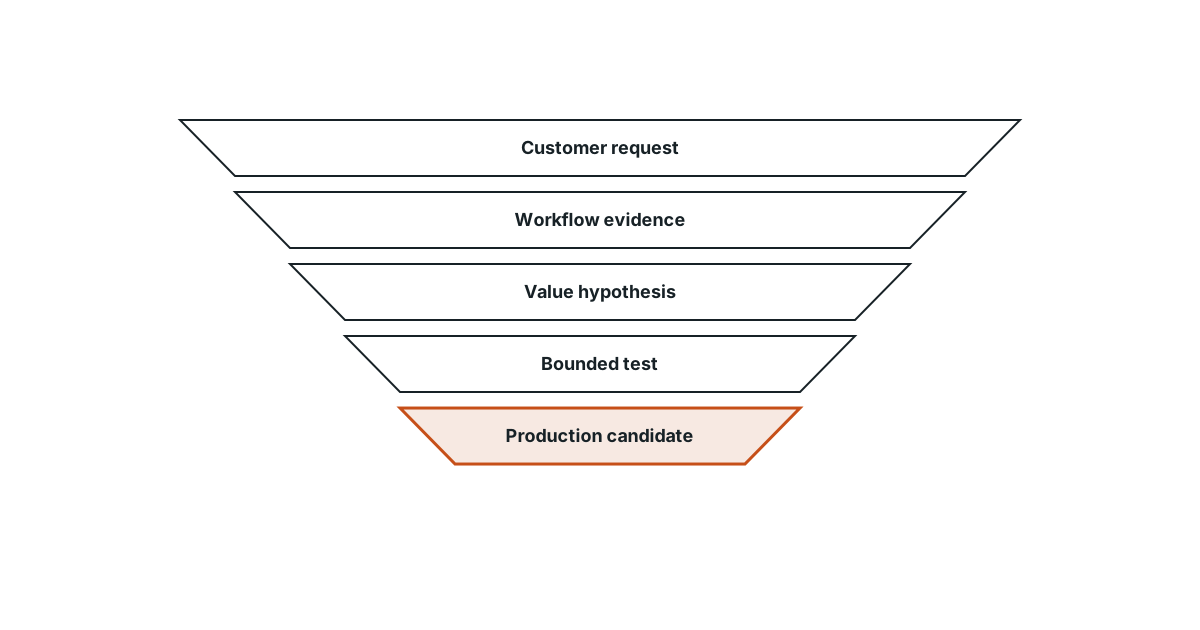
Field capacity belongs to consequential uncertainty
Use this guide at the portfolio intake point before an FDE team commits discovery and build capacity. It applies to customer-specific problems that may require production data, integration, workflow change, or product adaptation. It is more than deal qualification and less than a final implementation plan.
Why executive urgency is a weak selector
FDE demand is usually greater than capacity. Revenue, executive attention, and technical novelty dominate selection because they are visible. The hidden dimensions appear later: no authorized data path, no operator who will adopt the workflow, an irreversible production risk, or a solution that cannot be supported or returned to the product.
A team can also reject valuable field work by demanding certainty too early. The answer is a staged decision with explicit unknowns and a cheap discovery test, not one perfect score.
“build us an AI operations assistant”
Interviews reveal that the expensive failure is not answering questions but reconciling three maintenance approvals. The FDE test narrows to one plant, one approval path, a four-week window, and a measurable reduction in stalled work.
Qualify the workflow and value hypothesis
For each candidate, write the current workflow and consequence of failure before describing an AI solution. Identify the user, decision or job, baseline, pain, frequency, and accountable owner. Then test whether the problem requires field engineering or could be handled by documentation, standard configuration, a partner, support, or core roadmap.
Surface non-negotiables early: data rights, environment access, identity, deployment, evaluation, incident ownership, security review, and exit. A project that cannot observe its intended outcome is not ready for a production promise.
Run a bounded value test
Use hard gates for legal/authorized access, an accountable customer owner, a measurable value test, and a credible safe environment. Score softer dimensions such as strategic fit, repeatability, product feedback value, and opportunity cost.
Choose one of four outcomes: accept a bounded discovery, reshape the problem, route it to another function, or reject with reason. An accepted discovery has a time box, explicit questions, no implied production commitment, and a decision date.
Re-score after discovery. Replace assumptions with evidence about users, data, model performance, integration, adoption, and support. The team should be able to stop without treating sunk effort as proof of value.
Opportunity-qualification card
The opportunity-qualification card contains:
| Area | Evidence / decision |
|---|---|
| User outcome | User, workflow, baseline, consequence, frequency, and owner |
| Value test | Observable success, time window, and authoritative measurement |
| Product fit | Current capability, required extension, and rejected standard path |
| Repeatability | Transferable constraint/capability and customer-specific residue |
| Access feasibility | Data rights, environment, identity, approvals, and customer dependencies |
| Production risk | Blast radius, reversibility, incident owner, and prohibited effects |
| Adoption | Workflow change, champion, training, feedback, and usage evidence |
| Learning return | Product decision that the engagement can inform |
| Capacity | FDE effort, core-team dependency, support tail, and displaced work |
| Outcome | Accept discovery, reshape, route, or reject; owner and review date |
Attractive requests that should remain discovery
- Selecting by contract value while production feasibility is unknown.
- Calling repeated customer requests a product pattern without mechanism analysis.
- Starting a prototype before identifying user, baseline, and adoption owner.
- Treating customer access as an implementation detail.
- Letting a discovery phase become an unbounded delivery commitment.
Evidence
A current FDE practice description emphasizes working close to customer problems and bridging real deployment needs with product and engineering.
Baseten's company-authored article describes its framing of forward deployed engineering, customer work, and feedback to product.
Primary source · official-doc · checked Aug 26, 2026
Limit: It is one company's practice narrative, not independent evidence that its selection process produces better outcomes.
Agent and AI system design should favor simple, composable patterns and add complexity only when it improves measured outcomes.
Anthropic's engineering article describes workflow and agent patterns and recommends starting with simpler solutions where appropriate.
Primary source · official-doc · checked Aug 26, 2026
Limit: The examples and recommendations are first-party guidance, not a customer-opportunity qualification standard.
Field opportunities should be selected through a bounded value, feasibility, risk, adoption, repeatability, and learning decision.
The qualification card below turns portfolio selection into an auditable decision with rejection and reshape options.
Signal Studio author framework · reviewed Aug 26, 2026
Limit: Weights and hard gates depend on company strategy, product maturity, customer contracts, and regulatory context.
Limitations
Early opportunities contain uncertainty, and qualification can favor familiar customers or easily measured outcomes. Strategic learning may justify some nonrepeatable work. Record assumptions, revisit them, and protect against sales pressure changing technical evidence.
FAQ
- Should strategic customers bypass the qualification gate?
- They may justify different weights, but access, safety, ownership, success, and exit gates should remain explicit. Record the exception and opportunity cost rather than hiding it.
- Does repeatability mean several customers already asked for it?
- No. Similar requests can arise from different mechanisms. Repeatability requires a stable capability, interface, or constraint that can transfer without preserving one customer's custom implementation.
Related guides
Continue within Forward deployed engineering, or use one of these adjacent diagnostics:
Editorial QA: automated native-English, structure, source-presence, and link checks completed . This record is not an independent expert endorsement. Review boundary.