
Question-led guide · measurement
Which metrics show adoption, productization, and a healthy FDE exit?
An FDE operating scorecard for user outcomes, workflow adoption, reliability, reuse, knowledge return, support load, ownership transfer, and exit readiness.
Direct answer
Measure an FDE engagement as a chain: verified user outcome, sustained workflow adoption, production reliability, reusable capability, product decisions informed, support burden, customer and product ownership, and retirement of field-only dependencies. Revenue and launch count show commercial activity, not health. A good exit leaves a working system, competent owners, bounded support, documented evidence, and product learning that no longer depends on the original FDE.
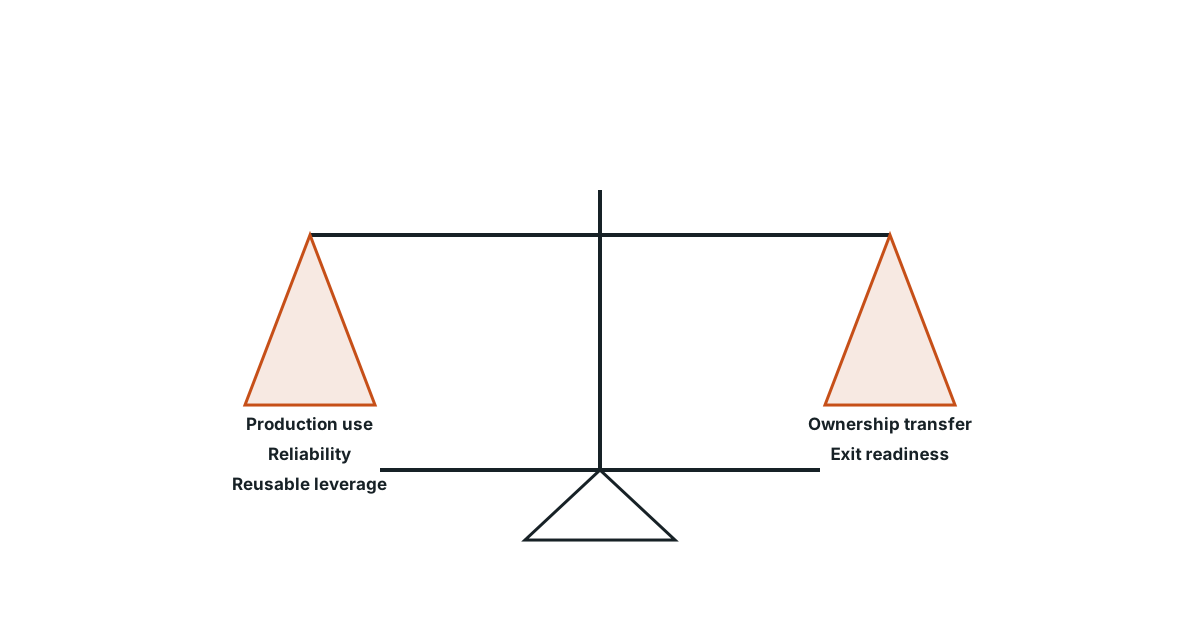
Measure the operating loop, not activity
Use this scorecard for individual engagements and the FDE portfolio. It tracks whether field work becomes durable value and reusable learning. It does not replace revenue, customer-success, product, or service-reliability reporting; it connects them.
Why utilization and launch dates mislead
Launch dates and contract value are easy to report. They occur before the hardest questions: do users rely on the workflow, does it improve the intended outcome, can it survive failures, did the product absorb the reusable capability, and can the field team leave?
Metrics can also reward the wrong behavior. Counting field tickets celebrates support load. Counting product requests rewards volume rather than decisions. Counting reuse by repository forks can preserve duplicated custom code.
A successful launch with no exit
A workflow has 80% weekly adoption and good reliability, yet every configuration change requires the same FDE. The scorecard marks productization and ownership transfer red, preventing launch success from hiding operational dependence.
Read adoption, reliability, leverage, and transfer together
Take a “successful” engagement and test the chain:
- Is the user outcome defined and independently observed?
- Which intended users complete the valuable workflow, and for how long?
- Does the system meet a user-relevant reliability objective?
- Which capabilities are reused without new field engineering?
- Which product decisions changed because of field evidence?
- How much ongoing support and manual repair remains?
- Can named owners operate, change, and recover the system?
- Which field-only assets can be retired?
A broken link narrows the claim. A launch with no adoption is a delivered system, not a realized outcome.
Build a balanced engagement scorecard
Define a small metric set per engagement before build, then roll it into portfolio views. Pair every rate with a denominator and decision. Use cohorts and observation windows for adoption. Track reliability through user outcomes, not only model calls.
Measure productization through supported capability reuse and retirement of custom paths. Measure knowledge return through decisions, accepted design changes, documentation, evaluation tasks, and reusable adapters—not slide decks delivered.
Set exit criteria early and review jointly with the customer and product owner. A deliberate long-term managed engagement can be healthy, but its ownership and economics should be explicit.
FDE operating scorecard
The operating scorecard contains:
| Dimension | Example evidence | Decision supported |
|---|---|---|
| User outcome | Baseline, verified change, attribution limits | Continue/reshape/stop |
| Adoption | Intended-user cohort, valuable workflow completion, retention | Training/workflow change |
| Reliability | SLI/SLO, serious failures, recovery, manual repair | Production readiness |
| Reuse | Supported capability used in new contexts without field branch | Productization investment |
| Product learning | Decisions changed, accepted artifacts, rejected assumptions | Roadmap/interface change |
| Support load | Incidents, escalations, hours, unique custom operations | Ownership/economics |
| Ownership | Runbooks, access, on-call, change authority, drills | Handoff readiness |
| Exit debt | Field-only code, credentials, dashboards, contracts, and owners | Exit date and cleanup |
Metrics that reward permanent dependence
- Reporting active users without the valuable workflow or target cohort.
- Calling copied code reuse when each copy remains independently supported.
- Counting field feedback volume instead of product decisions and outcomes.
- Declaring handoff after documentation without an operational drill.
- Using one score to rank FDEs across incomparable customer contexts.
Evidence
Service-level objectives connect reliability measurement to user-relevant service behavior and an explicit target.
Google's SRE book chapter explains service-level indicators, objectives, agreements, and selecting user-relevant reliability measures.
Primary source · official-doc · checked Aug 26, 2026
Limit: SLOs measure service behavior and do not by themselves establish adoption, product reuse, or a healthy organizational handoff.
Production readiness requires a portfolio of operational, data, model, testing, and monitoring practices beyond model performance.
The ML Test Score presents a rubric spanning testing, monitoring, infrastructure, data, and model practices.
Primary source · paper · checked Aug 26, 2026
Limit: The rubric predates generative agents and does not measure FDE adoption or organization exit directly.
FDE health should be measured across value, adoption, reliability, reuse, learning, support, and ownership transfer.
The operating scorecard below prevents launch and revenue from masking an unsustainable field dependency.
Signal Studio author framework · reviewed Aug 26, 2026
Limit: Metrics can be gamed and must be interpreted with qualitative evidence, customer context, and portfolio strategy.
Limitations
Attribution is difficult because product, customer teams, market conditions, and field work interact. Early metrics can be sparse, and strict exit targets can discourage appropriate long-term partnerships. Use the scorecard for decisions, not individual performance ranking alone.
FAQ
- Is weekly active usage an adoption metric?
- It can be one signal, but define the intended user and valuable workflow. Repeated opens, background automation, and mandatory use can inflate activity without proving a better outcome.
- When is an FDE exit healthy?
- When named customer and product owners can operate, support, change, and measure the system; remaining field obligations are bounded; and the original FDE is no longer a hidden dependency.
Related guides
Continue within Forward deployed engineering, or use one of these adjacent diagnostics:
Editorial QA: automated native-English, structure, source-presence, and link checks completed . This record is not an independent expert endorsement. Review boundary.