
Question-led guide · comparison
How does an FDE differ from solutions, consulting, and implementation roles?
A lifecycle responsibility matrix for comparing forward deployed engineers with solutions engineers, consultants, and implementation engineers.
Direct answer
Compare the roles by lifecycle responsibility, not title. An FDE commonly combines technical discovery, hands-on product extension or integration, production launch, adoption, and structured feedback to the core product. Solutions engineers often emphasize pre-sale architecture, consultants bounded advisory outcomes, and implementation engineers configured delivery—but companies vary. Define who owns code, production risk, user outcome, support, and productization in your organization.
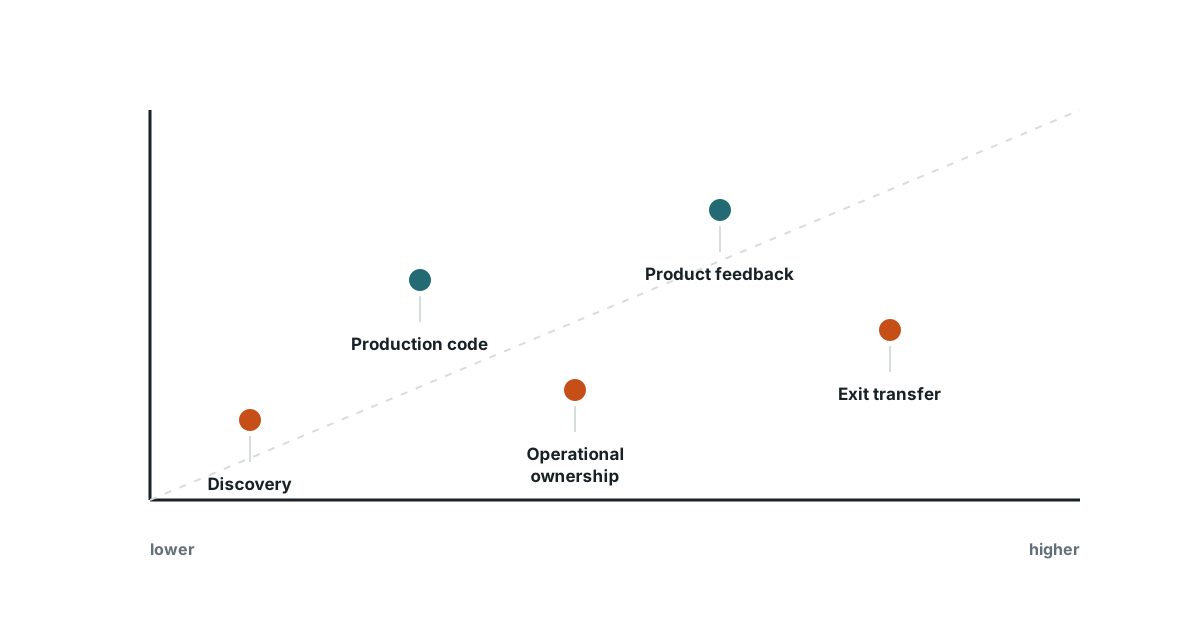
Compare responsibilities, not titles
Use this guide when designing a field organization, hiring, or clarifying handoffs among sales, services, engineering, and product. It compares responsibility surfaces. Compensation, career ladders, and billable-service accounting require separate design.
Why organizational labels overlap
Role comparisons begin with titles because titles are searchable. In practice, two companies can use FDE for different jobs, while one implementation engineer may own more production engineering than another company’s FDE. The same ambiguity appears in “solutions architect,” “applied AI engineer,” and “technical consultant.”
The organizational risk is an unowned transition. Discovery finds a real constraint but nobody can change the product. A prototype launches but no one owns adoption. Field code remains in production but core engineering assumes it was temporary. A matrix makes those gaps visible.
Who owns the first production incident
Sales engineering proved the demo, implementation configured the deployment, and an FDE changed product code. A responsibility matrix names who investigates production behavior, who approves a patch, and who carries the learning into the roadmap.
Map decision rights across the lifecycle
Take three recent customer engagements and identify who actually:
- framed the user and business problem;
- selected the technical approach and success test;
- wrote or reviewed production code;
- obtained data and environment access;
- launched, monitored, and supported the system;
- trained users and measured adoption;
- decided what became configuration, service, or product;
- returned evidence to product planning;
- accepted security and reliability risk;
- exited ownership.
Compare observed ownership with job descriptions and contracts. A role name that says “consulting” may still own production; a role named “engineering” may stop at a demo.
Choose the operating model the work requires
Define the role around a lifecycle and its decision rights. Specify what the role may promise, build, deploy, access, operate, and escalate. Make core product and customer responsibilities equally explicit.
FDE is most distinct when the same field team can translate ambiguous operational work into a bounded solution, carry it through production and adoption, and return reusable learning to the product. If the role stops before build, production, or feedback, name that boundary honestly rather than stretching the title.
Review the allocation after several engagements. Persistent overlap may be intentional; persistent unowned work needs a redesigned interface.
Field-role responsibility matrix
Complete the matrix with owns, contributes, approves, informed, or out of scope:
| Lifecycle responsibility | FDE | Solutions | Consulting | Implementation | Core product | Customer owner |
|---|---|---|---|---|---|---|
| Problem discovery | ||||||
| Value test and scope | ||||||
| Architecture and product fit | ||||||
| Code/configuration/integration | ||||||
| Production launch and reliability | ||||||
| Adoption and workflow change | ||||||
| Security/data access | ||||||
| Support and incident ownership | ||||||
| Product feedback/productization | ||||||
| Handoff and exit |
Role definitions built from prestige or reporting lines
- Defining roles from a single famous company.
- Comparing skills while ignoring authority and production ownership.
- Letting pre-sale teams promise field engineering capacity without acceptance criteria.
- Treating adoption and support as customer responsibilities by default.
- Naming product feedback as a duty without a receiving decision process.
Evidence
Palantir's current FDSE role description presents end-to-end technical work with users, from problem understanding through implementation.
The official job posting describes the responsibilities and expectations Palantir assigns to a Forward Deployed Software Engineer role.
Primary source · official-doc · checked Aug 26, 2026
Limit: A recruiting description is a company claim about one current role and location, not an industry-wide definition or outcome study.
OpenAI's current FDE role description includes deployment work, customer collaboration, and production-oriented technical responsibility.
The official career page describes responsibilities and qualifications for OpenAI's named FDE role.
Primary source · official-doc · checked Aug 26, 2026
Limit: The page is a recruiting artifact that can change and does not define solutions, consulting, or implementation roles across other firms.
Role design should allocate responsibility across discovery, build, launch, operation, adoption, and product feedback explicitly.
The lifecycle matrix below prevents title comparisons from hiding ownership gaps and overlapping authority.
Signal Studio author framework · reviewed Aug 26, 2026
Limit: Organizations should adapt the matrix to contracts, product maturity, sales model, geography, and regulatory responsibilities.
Limitations
Titles are unstable and company-specific. Job descriptions describe desired roles rather than observed daily work, and responsibilities vary by customer, product, contract, and region. This matrix supports organization design; it does not classify every individual.
FAQ
- Is an FDE simply a consultant who codes?
- That can describe some engagements, but it misses the product feedback and production-accountability dimensions many companies associate with FDE work. Use actual responsibilities and incentives, not the label.
- Can one person cover solutions engineering and FDE work?
- Yes, especially in an early company, but decision rights and handoffs still need to be explicit. Pre-sale incentives, production duty, and product commitments can conflict.
Related guides
Continue within Forward deployed engineering, or use one of these adjacent diagnostics:
Editorial QA: automated native-English, structure, source-presence, and link checks completed . This record is not an independent expert endorsement. Review boundary.