
Question-led guide · how-to
How should I model incidents, changes, deployments, and dependencies over time?
A temporal relation schema separating entity identity, changing state, events, valid time, record time, versions, provenance, and uncertain dependencies.
Direct answer
Model stable entities separately from events and time-bounded states. Give incidents, change proposals, commits, deployments, observations, and dependency assertions their own identity and provenance. Record valid time—when something held in the operational world—and record time—when the system learned it. Never overwrite topology with the latest snapshot; version relations, preserve uncertainty, and query the graph as it was known at the incident time.
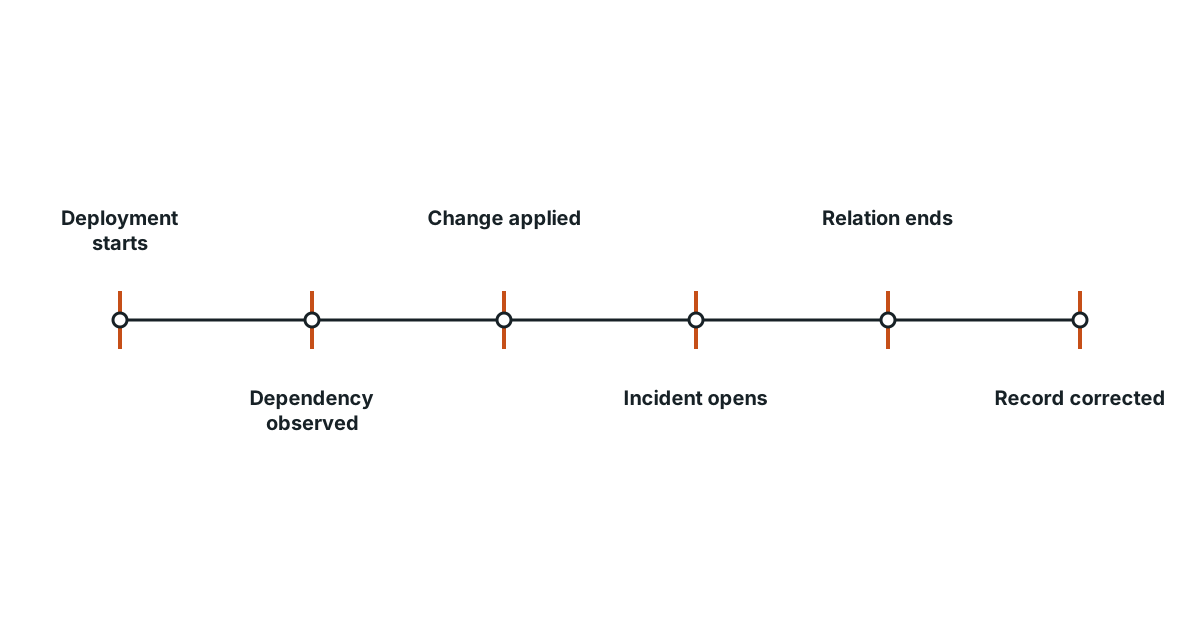
Operational truth changes with time
Use this schema for operational knowledge graphs, CMDBs, catalogs, and investigation systems that must answer historical questions about incidents, changes, deployments, and dependencies. It focuses on semantics; implementation may be relational, event-sourced, graph-based, or hybrid.
Why timeless edges rewrite history
Inventory systems store current state because it is efficient for dashboards. When an incident occurs, investigators query today’s owner, dependency, and deployment graph and assume it describes the event. Later corrections silently rewrite what the agent appeared to know.
Time is also reduced to one timestamp. A deployment started, progressed, paused, completed, and rolled back. A dependency existed only for one traffic cohort. A change was approved earlier than it was committed and observed later. One timestamp cannot preserve these meanings.
A dependency removed after the outage
A service depended on Redis during an incident but not when the RCA ran. The relation retains its valid interval and source, allowing the investigation to reconstruct the incident topology without treating the edge as current.
Separate valid time from observation time
Take a historical incident and ask the system twice:
- What was operationally true during the impact interval?
- What evidence had been recorded and was available to the investigator at that time?
Different answers are expected. If the model cannot express them, later knowledge can leak into incident replay and causal claims.
Review each timestamp field and name its clock, source, precision, timezone, and semantic role: proposed, approved, started, committed, observed, valid from, valid to, recorded, corrected, or invalidated.
Represent events and time-qualified relations
Keep durable entity identity separate from state assertions. Model a dependency as a versioned assertion or observation with subject, object, relation type, valid interval, record interval, source, discovery method, confidence/status, and evidence. Do the same for ownership and configuration state.
Represent changes as proposals and commits; deployments as activities with target, artifact version, stages, and outcomes; incidents as impact and coordination records with observed intervals. Link them through provenance and identity without collapsing temporal proximity into causality.
Support as-of queries along both axes. Corrections append a new record and close the prior record-time interval; they do not erase the historical view used by an earlier decision.
Temporal relation schema
Use this relation shape:
assertion_id: rel-...
subject: {type: service, id: svc-17}
predicate: depends_on
object: {type: service, id: svc-42}
valid_time: {from: 2026-08-25T09:00Z, to: 2026-08-25T11:30Z, precision: minute}
record_time: {from: 2026-08-25T09:04Z, to: 2026-08-26T02:10Z}
source: {system: trace-derived-topology, record: ..., observed_at: ...}
method: observed_requests
status: supported
confidence: {value: 0.82, meaning: mapping-policy-v3}
superseded_by: rel-...
limitations: [sampling, only-us-east-traffic]
Use analogous typed records for change, deployment, incident, and observation events rather than one generic event table with opaque payloads.
Graphs that project current topology onto old incidents
- Overwriting current topology and using it for historical RCA.
- Naming every timestamp
created_atorevent_time. - Treating approval, commit, rollout, observation, and impact as one change time.
- Storing confidence without its method or interpretation.
- Using a later correction during replay without labeling hindsight.
Evidence
The W3C Time Ontology provides concepts for instants, intervals, durations, temporal positions, and temporal relations.
The W3C Recommendation defines an OWL vocabulary for representing temporal concepts on the Web.
Primary source · standard · checked Aug 26, 2026
Limit: The vocabulary does not prescribe bitemporal storage, incident schemas, clock-quality controls, or an operational database.
PROV-O models entities, activities, agents, generation, use, derivation, and invalidation for provenance over processes and artifacts.
The W3C Recommendation supplies provenance classes and relations useful for change and deployment lineage.
Primary source · standard · checked Aug 26, 2026
Limit: Provenance does not by itself establish temporal completeness, correctness, or causal impact.
Operational temporal modeling should separate event occurrence, state validity, observation time, and knowledge correction.
The temporal-relation schema below prevents later topology and knowledge from leaking into historical analysis.
Signal Studio author framework · reviewed Aug 26, 2026
Limit: Source clocks can be wrong, intervals can be uncertain, and full history can be expensive to retain and query.
Limitations
Distributed clocks, delayed ingestion, missing events, source corrections, and uncertain dependency discovery complicate temporal truth. Storage and query costs can be substantial. Define the precision and history needed for actual competency questions.
FAQ
- Is event time the same as valid time?
- An event occurs at an instant or interval. A state or relationship can become valid because of the event and remain valid for another interval. Model both when the distinction affects decisions.
- Why store record time?
- It shows what the system knew when a decision was made and supports correction audits. A fact can be valid yesterday but discovered today, or recorded yesterday and corrected today.
Related guides
Continue within Ontology and operational semantics, or use one of these adjacent diagnostics:
Editorial QA: automated native-English, structure, source-presence, and link checks completed . This record is not an independent expert endorsement. Review boundary.