
Question-led guide · how-to
How do I release MCP tool changes while hosts cache old catalogs?
Plan an MCP catalog migration with compatible server behavior, measured host adoption, cache failure tests, and evidence-based retirement.
Direct answer
Release MCP tool changes by first deploying behavior that supports the old and new contracts, then activating the new catalog for identifiable host cohorts. Measure the definitions hosts actually use, exercise missed invalidation and offline-client paths, and retain a compatible reversal. Remove old behavior only after observed adoption and explicit retirement criteria; a cache TTL or a delivered notification does not prove migration.
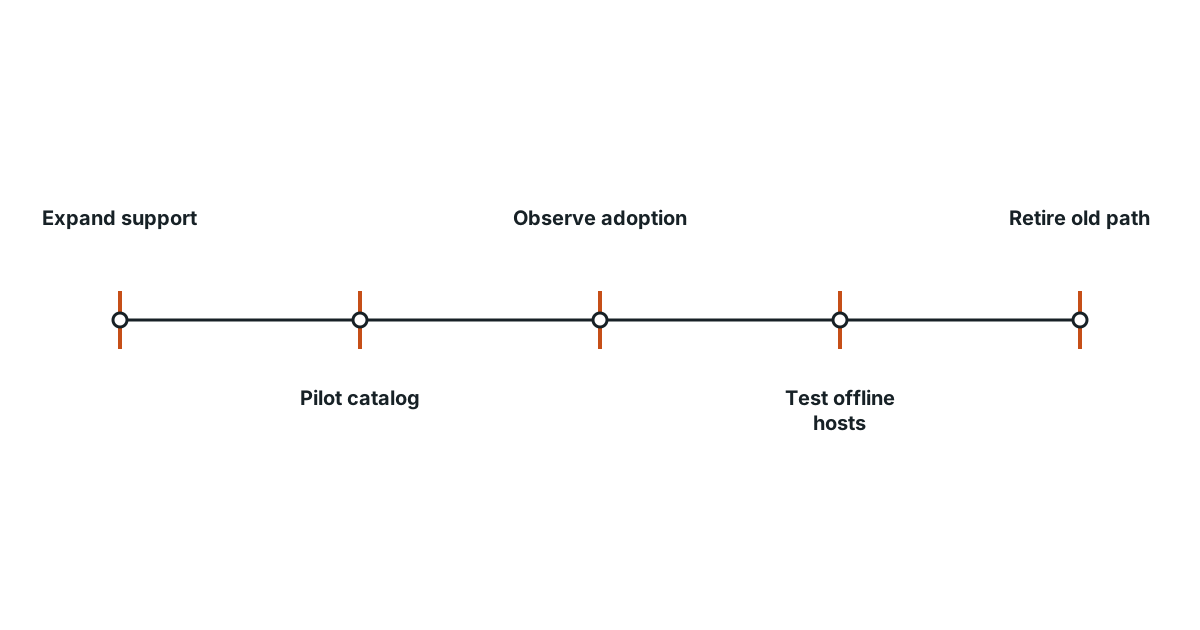
A deployment can finish before a release reaches hosts
Replacing server replicas changes execution, while a catalog update changes the definitions offered to models. A host that retains the previous definition may continue constructing old arguments against the new implementation. The rollout therefore includes at least two adoption events, often owned by different teams.
Choose observable markers for both. Record the deployed behavior revision and the host’s active catalog revision with candidate traffic. If hosts cannot report their definition revision, identify that measurement gap before claiming complete migration.
Freshness hints leave a migration gap
The MCP caching specification treats TTL as a freshness hint and supports notification-based invalidation. It also permits stale responses during refresh failures. A release cannot assume that wall-clock age proves every consumer refreshed successfully.
Use a local activation policy that states which catalog revisions may still execute. Refresh mechanisms help distribute change; the policy determines the response when a host presents an old or unknown definition. For a harmless lookup, a supported old contract may remain available. For a suspended capability, refresh failure must not preserve authority.
Ninety hosts refresh while ten stay offline
Consider a hypothetical asset assistant with 100 managed hosts. Catalog 31 uses asset.lookup; catalog 32 introduces asset.find with clearer scope and a revised result. The server initially supports both names with their respective promised behavior.
During the pilot, ninety hosts adopt catalog 32 and ten laptops remain offline. The release team sees zero old-name calls for an hour. That is insufficient retirement evidence: the absent hosts still exist and may return with an old definition.
The team keeps compatibility until every supported returning host either refreshes before execution or receives a clear upgrade-required response. One offline-host drill exposes a startup cache that ordinary canary traffic never exercised.
Use a migration board with observable exits
This release artifact records what must be true before progressing. The proposed gates are illustrative and need risk-specific ownership.
| Stage | Change | Evidence to advance | Failure response |
|---|---|---|---|
| Expand | Server accepts both documented contracts | Old and new host checks pass | Restore prior server before new activation |
| Pilot | Small named cohort sees new definition | Correct selection, rendering, and catalog identity | Freeze cohort and restore compatible activation |
| Broaden | Additional supported hosts refresh | Adoption and outcomes compared with control | Stop expansion and inspect affected path |
| Return test | Offline host reconnects with old cache | Refresh or explicit supported rejection | Keep old support while adapter is corrected |
| Retire | Remove old selectable definition and handler | Remaining consumers resolved; support deadline met | Use agreed recovery path, not silent alias substitution |
Attach the exact catalog, server, policy, and backend versions. A rollback action is valid only for combinations already supported by the compatibility matrix.
Select canaries by the paths they cover
Canary release guidance provides the candidate-versus-control framework. For MCP, choose hosts that exercise different client builds, cache behavior, tool-selection contexts, and relevant result renderers. A random percentage dominated by one popular read tool may never touch the changed path.
Compare the offered definition, selected tool, accepted arguments, result interpretation, and user outcome. Protocol error rates are useful but cannot identify a model that now selects an unintended tool while every request remains valid.
Rehearse stale and mixed states explicitly
Test missed notifications, refresh failure, returning offline hosts, and partial catalog fetches. Record whether the host preserves a permitted old snapshot, rebuilds consistently, or stops the affected capability. Avoid silently merging fragments of different catalog generations into an unreviewed definition set.
For stateful workflows, decide which contract handles work started before activation. This guide does not prescribe the workflow state machine; it requires the release to identify that dependency and exercise the supported transition.
Retire behavior with consumer evidence
Old traffic reaching zero is useful evidence only relative to the expected consumers and their activity cycle. Combine it with fleet inventory, supported-host return behavior, owner acknowledgments where necessary, and explicit handling of unknown clients.
After retirement, retain the old identity in historical records so earlier selections remain explainable. For an unsafe tool, containment can override graceful coexistence. Record that as a suspension with user-visible consequences, not a successful ordinary migration.
Evidence
MCP caching combines freshness hints with optional change notifications.
The caching rules distinguish TTL freshness hints, invalidation notifications, and potentially stale responses after refresh errors.
Primary source · standard · checked Sep 8, 2026
Limit: The protocol does not provide an organization-wide acknowledgment that every host adopted a release.
Canary releases require a bounded candidate population and evaluation against a control.
Google's release guidance describes canary selection, evaluation, and decisions about candidate rollout.
Primary source · official-doc · checked Sep 8, 2026
Limit: Generic canary analysis does not determine whether an MCP cohort exercised rare tool-selection or catalog-cache paths.
Limitations
The migration board is an operational pattern, not a protocol feature. Remote hosts may not report catalog identity, low-volume paths may escape a canary, and backend changes can make rollback impossible. Critical exposures can require immediate suspension instead of gradual migration.
FAQ
- Is a five-minute catalog TTL a five-minute migration guarantee?
- No. It describes a cache freshness hint, not successful refresh and activation at every host. Offline consumers, refresh failures, and host implementation differences require observed adoption and a fallback policy.
- Can I shadow a side-effecting candidate tool?
- Only across a boundary that cannot commit real effects. Compare selection, validation, or simulated behavior with appropriate data controls; duplicating a live write request is not harmless shadow evaluation.
Related guides
Continue within MCP in production, or use one of these adjacent diagnostics:
Editorial QA: automated native-English, structure, source-presence, and link checks completed . This record is not an independent expert endorsement. Review boundary.