
Question-led guide · decision
What must be versioned in an MCP client-server contract?
Build a directional compatibility matrix across MCP protocol revisions, host builds, server artifacts, tool definitions, policy, and backend behavior.
Direct answer
Version the protocol rules, host and client implementation, server artifact and SDK, model-facing catalog, tool behavior, policy, and relevant backend contract separately. Compatibility is a directional claim about a tested combination of those components. Record supported, constrained, unsupported, and untested combinations explicitly; neither an unchanged protocol date nor a minor package release establishes that older hosts will preserve the intended behavior.
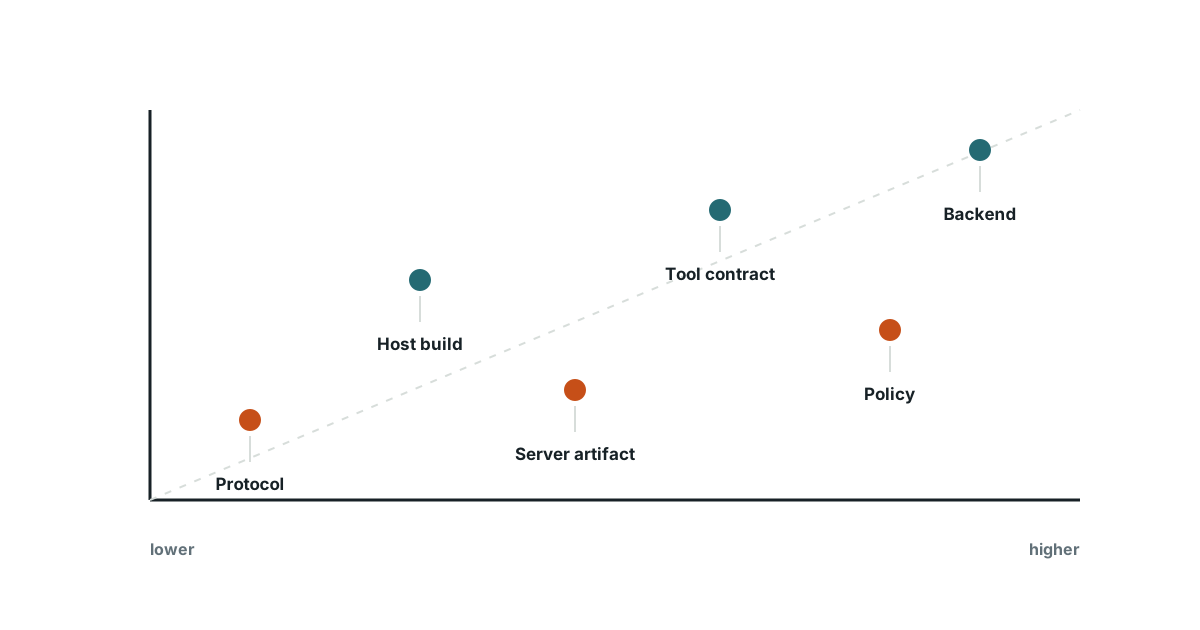
Ask which component’s version changed
“We upgraded MCP” is insufficient for a release decision. It might mean a new protocol revision, a client SDK update, a server image, or a tool description change. Those changes have different consumers and can fail independently.
Maintain a short component inventory with owners and verified sources of version information. Deployment supplies the server artifact; the host records the catalog used for selection; policy supplies the decision revision. Preserve a peer’s self-reported build as a claim when it cannot be tied to an admitted artifact.
Separate wire compatibility from meaning
The 2026-07-28 transport specification changes the protocol’s session model and request metadata requirements. Mixing its rules with a legacy implementation can fail before tool logic executes.
After the wire works, application compatibility remains. A caller can send valid JSON and receive a schema-valid result whose units, absence semantics, ordering, or scope changed. Record those promises in the tool contract and test the direction that matters: old caller to new server is not the same claim as new caller to old server.
An optional field changes the meaning of a missing price
Take a hypothetical inventory tool returning price and currency. Server revision 8 introduces an optional include_estimates input and a new price_status result. A new host recognizes estimated; an old host ignores the field and displays every numeric price as confirmed.
The input addition is harmless only if its default preserves the old result meaning. The team decides that callers omitting include_estimates will still receive confirmed prices or explicit absence. Estimated prices require an admitted new host and a distinct result contract.
Both host generations can now coexist, but only under recorded constraints. Merely accepting the old request shape would have missed the user-visible incompatibility.
Record combinations and their permitted behavior
Use a matrix like this for the affected contract. The labels and outcomes are hypothetical and should be replaced with tested local versions.
| Consumer | Producer | Contract condition | Support decision | Required evidence |
|---|---|---|---|---|
| Host 4, catalog 21 | Server 7, confirmed prices | Existing behavior | Supported baseline | Known-price and absent-price tests |
| Host 4, catalog 21 | Server 8, estimates omitted | Confirmed-only default retained | Supported with constraint | Old rendering and default tests |
| Host 5, catalog 22 | Server 8, estimates requested | Status displayed explicitly | Supported for pilot | Estimate labeling and user review |
| Host 5, catalog 22 | Server 7 | New input unavailable | Unsupported | Explicit rejection check |
| Unidentified host | Either server | Result interpretation unknown | Untested | Identify consumer before admission |
Attach protocol revision, SDK builds, artifact digests, policy revision, backend API, test date, and owner to the matrix. The compact rows summarize a claim; they do not replace the evidence supporting it.
Use version labels to communicate a defined promise
Semantic Versioning is useful when a component declares its public API and follows the convention. Establish which behaviors belong in that API, including defaults and result meaning. Do not assume that a protocol date, registry record, model label, and container tag share one ordering scheme.
Compatibility review should include descriptions when models consume them to select tools. A wording change can redirect calls without changing a parser. Evaluate those selection consequences against a recorded task set rather than attempting to infer them from the release number.
Retest the boundary implicated by the change
Organize checks around changed promises: wire handling, omitted inputs, result interpretation, permitted fields, cache reuse, and recognizable failures. Keep representative old clients until their support period ends. Include a test where the new host accidentally reaches an old server and must fail clearly.
For stochastic selection, record the model and host configuration and compare repeated representative tasks. A deterministic schema test and a selection evaluation establish different parts of the same support claim.
Expire support deliberately
Give each constrained row an owner and removal condition. Observe which real consumers still use it, including infrequent workflows, before retiring compatibility code. If a combination was never exercised, preserve that uncertainty instead of converting “no reported failures” into a pass.
The matrix answers which combinations are permitted. Rolling out with stale catalogs addresses how to move production from one permitted combination to another.
Evidence
The 2026-07-28 Streamable HTTP revision changes earlier transport behavior.
The revision removes protocol-level sessions and requires version metadata on requests.
Primary source · standard · checked Sep 8, 2026
Limit: A supported transport revision says nothing about application-specific defaults or output interpretation.
Semantic Versioning depends on a declared public API and classifies changes against that API.
SemVer distinguishes incompatible API changes from backward-compatible additions and fixes.
Primary source · standard · checked Sep 8, 2026
Limit: Not every MCP-related version string follows SemVer, and compliance is a publisher promise rather than runtime proof.
Limitations
The matrix is an author-designed support record. Tests cover their recorded host, model, tool, and environment settings, not all future hosted-model changes. Peer-reported implementation versions also need independent deployment evidence where available.
FAQ
- Is an optional tool input always backward compatible?
- Only for callers whose previous behavior stays valid. New defaults, data access, cache semantics, selection language, or result interpretation can change the outcome even when old JSON remains accepted.
- Must every possible version combination be tested?
- No. Define a deliberately limited supported matrix based on actual consumers and consequential behavior. Label the remaining combinations untested or unsupported instead of inferring support from nearby versions.
Related guides
Continue within MCP in production, or use one of these adjacent diagnostics:
Editorial QA: automated native-English, structure, source-presence, and link checks completed . This record is not an independent expert endorsement. Review boundary.