
Question-led guide · diagnostic
Why does my RCA bot always blame the last error in the trace?
A hypothesis-led method for stopping an incident agent from confusing the final recorded error with the mechanism that produced the outage.
Direct answer
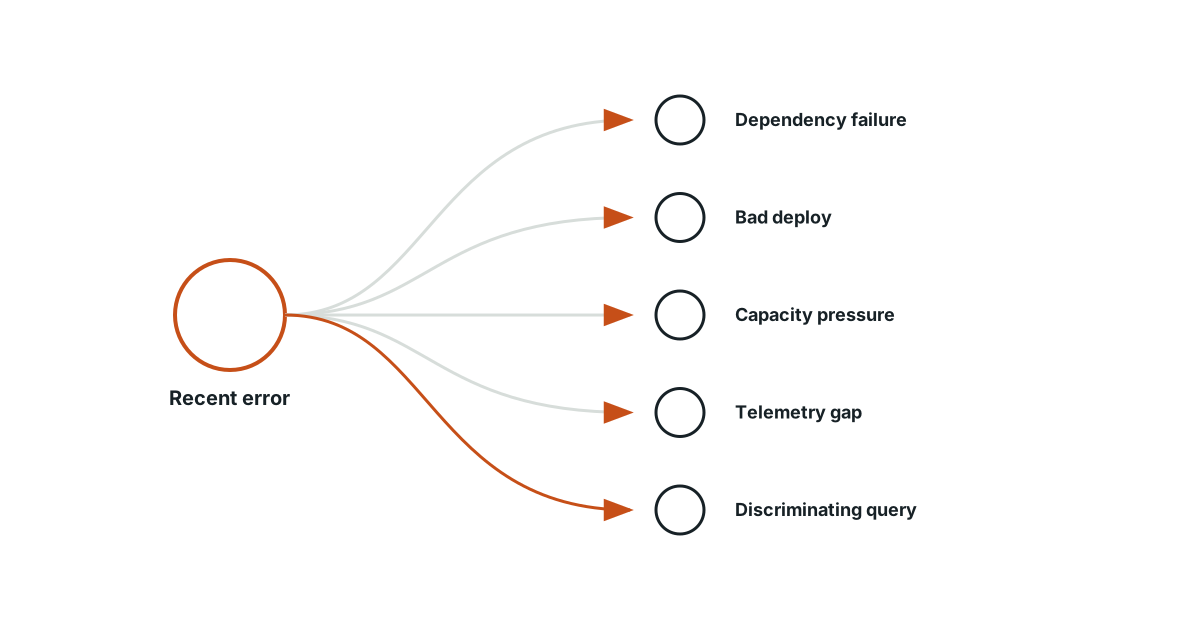
An RCA bot blames the last trace error because recency is an easy ranking signal and many traces expose consequences more clearly than initiating conditions. Replace narrative completion with hypothesis testing: anchor the user impact, compare failing and healthy populations, trace backward across causal boundaries, require counterevidence, and keep the last error as one observation until a discriminating test supports a mechanism.
Recency is not causal relevance
Use this guide when an incident assistant repeatedly selects the terminal exception, the reddest span, or the most recent deployment and presents it as root cause. The method is designed for diagnosis of distributed services with request traces plus at least one comparison signal. It does not authorize remediation and does not replace the broader evidentiary test for a root-cause claim.
How the last error becomes an anchor
Trace viewers are arranged in time, so the last visible error feels like the conclusion of a story. Models strengthen that bias: the last exception is compact, legible, and close to the final answer, while an initiating queue, exhausted pool, stale configuration, or dependency slowdown may be represented only indirectly.
The trace is also conditioned on what was recorded. A downstream span may contain an explicit timeout because the caller knows it failed; the overloaded dependency may emit no error at all. Retries can place a late error after the condition that consumed the original latency budget. A bot trained or prompted to return one cause will compress those ambiguities into a confident narrative.
The last error belongs to a healthy retry
The final trace error is a transient timeout followed by success, while earlier spans show rising queue delay across all attempts. A hypothesis ledger keeps retry noise separate from the mechanism that explains the user-facing latency.
Build competing hypotheses
Start with a counterexample test. Select one incident where the bot blamed the final error, then collect a healthy comparison from the same route and version.
- State the affected user outcome and time window before naming a component.
- Mark every error as
initiating candidate,propagated consequence,recovery action, orunclassified. - Compare failing and healthy flows at each boundary: queue, service, datastore, external API, and control plane.
- Ask whether healthy requests also contain the alleged cause and whether failed requests can bypass it.
- Identify the earliest divergence in behavior, which is different from the earliest error timestamp.
- Require one competing hypothesis and one observation that would discriminate between the two.
If the bot cannot state what evidence would change its mind, it is producing a summary, not conducting an investigation.
Query to falsify, then stop honestly
Change the agent contract from find_root_cause(trace) to an impact-led loop. The first tool call should retrieve a bounded affected population. Subsequent calls should compare cohorts, inspect boundaries, and add observations to a ledger. Do not let the ranker use recency or span status as sufficient evidence; treat them as candidate features.
Give the agent explicit claim states: symptom, candidate location, supported mechanism, and unresolved. Promote a hypothesis only after a test produces the predicted difference and the agent has searched for material counterevidence. Store query references so an incident commander can reproduce the result.
Incident hypothesis ledger
Use one row per live hypothesis:
| Field | Required entry |
|---|---|
| Impact boundary | User outcome, affected cohort, interval, and error budget consequence |
| Hypothesis | A falsifiable mechanism, not a component label |
| Supporting observations | Stable query or trace references and what each observation establishes |
| Counterevidence | Healthy paths, bypass failures, timing conflicts, or data that weakens the mechanism |
| Predicted difference | What should be observable in affected versus control populations |
| Next test | The safest query or experiment that separates this hypothesis from a competitor |
| Observation gap | Missing signal, sampling, clock, topology, or change evidence |
| Claim state | candidate, weakened, supported, rejected, or unresolved |
The last trace error may remain in the ledger. It simply receives no privileged status because of its position.
RCA prose that jumps from event order to mechanism
- Replacing “last error” with “first error” without changing the reasoning method.
- Comparing requests from different releases, regions, tenants, or traffic classes.
- Treating a component with many error spans as the component that initiated the failure.
- Asking for a confidence percentage without a calibrated relationship between evidence and correctness.
- Deleting rejected hypotheses, which removes the audit trail that explains why the final candidate survived.
Evidence
Effective troubleshooting begins with a problem report and hypotheses, then tests those hypotheses instead of following one apparent clue indefinitely.
Google's SRE troubleshooting chapter describes systematic problem definition, hypothesis generation, testing, and examination of component boundaries.
Primary source · official-doc · checked Aug 26, 2026
Limit: The chapter is general operational guidance; it does not prescribe an LLM-agent ranking algorithm or prove that every last error is secondary.
Comparing request flows can localize where performance behavior diverges without assuming the latest event is causal.
The Spectroscope paper develops request-flow comparison to diagnose performance changes and demonstrates the value of population-level path differences.
Primary source · paper · checked Aug 26, 2026
Limit: The evaluated systems and 2011 tracing environment differ from modern agentic RCA systems, and localization is not causal proof.
A ranked list of causal candidates should retain supporting evidence, counterevidence, and the next discriminating test.
The hypothesis ledger below makes recency bias reviewable and gives the agent an explicit alternative to a single finished story.
Signal Studio author framework · reviewed Aug 26, 2026
Limit: Thresholds and required tests must be calibrated to local architecture, telemetry quality, and incident severity.
Limitations
This method cannot recover events outside the observed boundary, correct bad clocks, or prove counterfactual causality from telemetry alone. Async messaging, retries, sampling, shared dependencies, and control-plane changes may make the initiating condition invisible in a single trace.
FAQ
- Is the final error ever the root cause?
- Yes. It may be the initiating failure, but its position in a recorded trace is not evidence of that role. The agent still needs a mechanism and a comparison that distinguishes it from downstream consequences.
- Should I simply reverse the trace and inspect the first error?
- No. The first recorded error can also be a victim, a retry artifact, or an incomplete observation. Search by impact, boundaries, cohorts, and competing mechanisms rather than by trace position alone.
Related guides
Continue within AI agents for SRE and root cause analysis, or use one of these adjacent diagnostics:
Editorial QA: automated native-English, structure, source-presence, and link checks completed . This record is not an independent expert endorsement. Review boundary.