
Question-led guide · comparison
GEO vs SEO: what actually changes?
A responsibility matrix separating durable SEO foundations from the evidence design and answer-level observations added by generative search experiences.
Direct answer
GEO does not replace SEO. Crawlability, indexing, canonical URLs, useful content, internal links, reputation, and intent still determine whether systems can find and trust a page. GEO adds an answer-level lens: can a system retrieve the right passage, understand a bounded claim, distinguish support from limitation, select the source, and cite it accurately? It also requires reproducible observation across volatile engines instead of treating a ranking as the only visibility event.
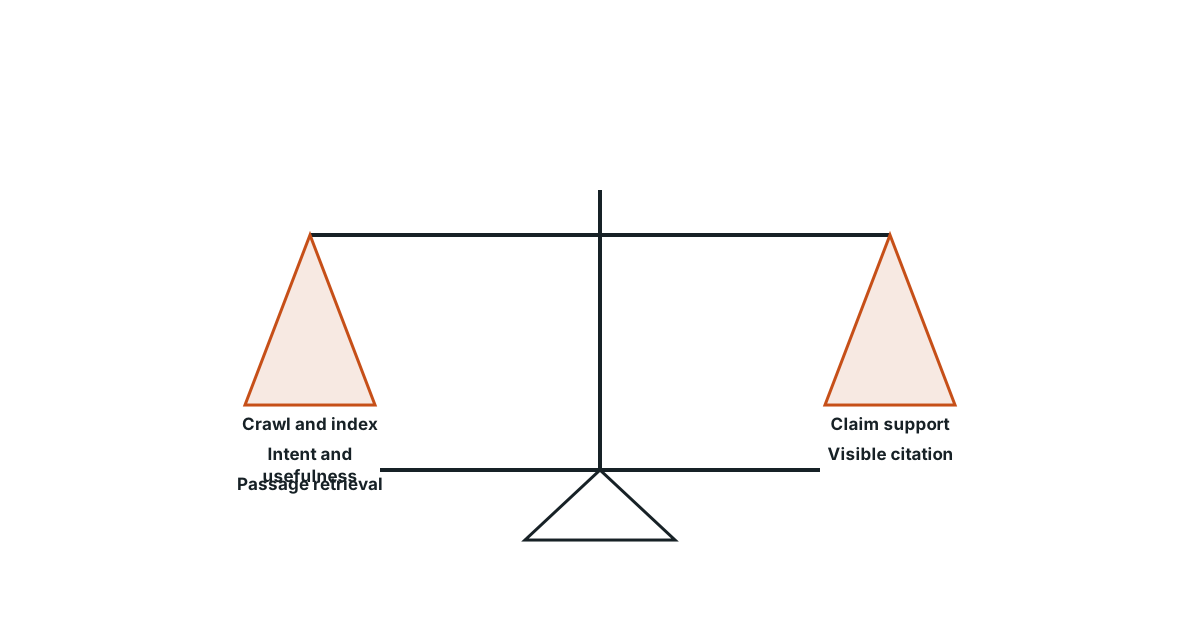
One page, two observation surfaces
This guide compares operational responsibilities for a technical publisher. It focuses on public informational content, not product feeds, local search, shopping protocols, or paid placement. The same page should serve humans first and remain understandable without an AI interface.
Why the replacement narrative is wrong
SEO is often reduced to blue-link ranking, while GEO is marketed as a new set of formatting tricks. That false split ignores the shared dependency: answer systems still need accessible sources and retrieval signals. It also hides a real difference: a generated answer may extract one claim from a page, combine it with other sources, and expose a citation or no citation at all.
Ranking without citation, citation without click
A page ranks in conventional results yet is not selected in one answer interface; another run cites it but sends no visit. The team records these as different outcomes instead of inventing one combined “GEO rank.”
Separate foundation from answer-level feedback
Separate the questions:
- Can crawlers fetch the page and assets?
- Is the canonical page indexable and discoverable?
- Does it satisfy a clear user intent with original value?
- Can a relevant passage be retrieved for the question?
- Is the claim bounded, supported, attributable, and current?
- Was the source selected and visibly cited in this run?
- Did the user visit, use the artifact, view the book, or leave?
The first three are familiar SEO foundations. The next three are the additional answer-level observation surface. The last is product behavior, not ranking.
Run one technical and editorial quality system
Keep one canonical content and technical-quality system. Add evidence design: lead with a direct answer, define scope, show mechanism, provide a usable artifact, map claims to primary sources, state limitations, display authorship and dates, and maintain corrections. Then run a fixed question set across documented interfaces and archive the conditions and visible sources.
Do not optimize for phrase density or imitate model prose. A page should retain value if no crawler ever cites it. Its unique evidence, tested procedure, or reusable artifact is the durable advantage.
SEO–GEO responsibility matrix
| Responsibility | SEO foundation | GEO addition | Shared quality test |
|---|---|---|---|
| Access | HTTP, robots, rendering | Purpose-specific crawler review | Public page returns usable HTML |
| Discovery | Links, sitemap, canonical | Experimental source and answer surfaces | One stable authoritative URL |
| Content | Intent, usefulness, originality | Bounded answer and evidence unit | Reader can act without another search |
| Entities | Clear authorship and subject | Stable source and work relationships | Names, dates, and claims agree |
| Measurement | Queries, pages, clicks | Fixed questions, visible sources, support review | Conditions, numerator, denominator, date |
| Distribution | Earned links and audiences | Purpose-specific derivatives with canonical | No fake consensus or duplicate spam |
GEO tactics that damage durable search value
- Declaring SEO obsolete and neglecting indexing or canonical hygiene.
- Publishing many thin question variants instead of one strong guide.
- Treating schema markup or llms.txt as a visibility guarantee.
- Counting a brand mention with no source as a confirmed citation.
- Reporting AI citation rate without the question set, engine, interface, locale, and date.
Evidence
Google states that established SEO practices remain foundational for visibility in its generative search features.
Google's guide says generative features rely on core search systems and recommends valuable content, technical structure, crawlability, indexing eligibility, and existing SEO best practices.
Primary source · official-doc · checked Aug 25, 2026
Limit: This describes Google Search and does not disclose ranking weights or behavior of other answer engines.
Scaled content that adds little user value can violate Google spam policy regardless of whether AI helped produce it.
Google advises focusing on accuracy, quality, relevance, and original value and warns against scaled low-value generation.
Primary source · official-doc · checked Aug 25, 2026
Limit: Meeting guidance does not guarantee crawling, indexing, ranking, or citation.
The access-to-behavior GEO pipeline is an author framework for diagnosing observable stages.
The staged model prevents teams from changing prose when the earliest failure is access, indexing, or retrieval.
Signal Studio author framework · reviewed Aug 25, 2026
Limit: Engines do not expose every internal stage, so some classifications remain informed inference.
Limitations
GEO is not a standardized discipline, and engines expose incomplete, changing information about retrieval and citation. This comparison is an operating model, not a claim that specific page changes cause citations or sales.
FAQ
- Do I need separate GEO pages for every question variation?
- No. Publish one strong page when the intent and solution are the same. Creating near-duplicate variations primarily for visibility can reduce usefulness and create cannibalization.
- Is llms.txt required for GEO?
- No. Treat it as an experiment where relevant. It does not replace accessible HTML, robots controls, sitemaps, canonical URLs, internal links, or useful content.
Related guides
Continue within SEO and GEO for technical sites, or use one of these adjacent diagnostics:
Editorial QA: automated native-English, structure, source-presence, and link checks completed . This record is not an independent expert endorsement. Review boundary.