
Question-led guide · diagnostic
My page is not cited by AI—where should I diagnose first?
A staged diagnostic that checks access, indexing, retrieval, source selection, claim support, citation behavior, and measurement before rewriting a page.
Direct answer
Start with access, not wording. Confirm the exact canonical URL returns usable public HTML, is allowed for the relevant crawler purpose, is internally linked, and is eligible for indexing. Then test whether the page actually answers the observed question with a distinct, supported claim. Only after access, indexing, and retrieval evidence are sound should you investigate source selection and visible citation. Repeat the exact question under recorded conditions before concluding there is a pattern.
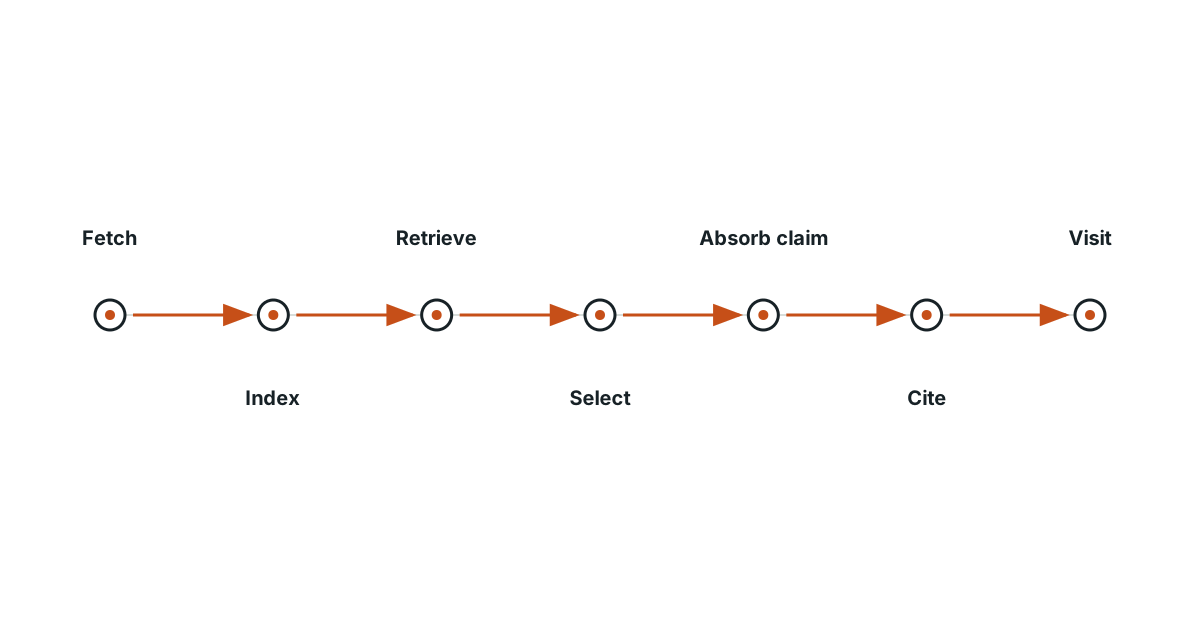
A missing citation has several possible causes
Use this for a specific public page and a specific non-branded or branded question. Record engine, interface, locale, login state, date, exact question, whether web search was visible, answer archive reference, and visible sources. Do not begin with an aggregate “AI visibility” score that hides those conditions.
Why editing prose may target the wrong stage
Teams collapse several failure modes into “the model does not like our content.” The page may be blocked, canonicalized elsewhere, unindexed, irrelevant to the actual question, retrievable but weaker than competing sources, absorbed without visible citation, or never considered because the interface did not search the web. Each stage needs different evidence and action.
A useful page excluded by canonical error
The guide is fetchable and high quality, but its canonical points to an old URL that returns unrelated content. Indexing diagnostics fail before retrieval, so the team fixes canonicalization and waits for recrawl rather than rewriting the article.
Test the pipeline from fetch to visible source
- Access: Fetch the canonical page and robots policy with the relevant user-agent class. Check HTTP status, WAF, rendering, and public assets.
- Canonical and indexing: Confirm one HTTPS canonical, internal links, sitemap presence, no
noindex, and available search-console evidence. - Intent: Compare the exact question with the page’s direct answer, audience, scope, and decision.
- Retrievability: Identify the passage that should answer the question without relying on navigation or hidden client state.
- Evidence advantage: Name the original artifact, first-party observation, bounded framework, or synthesis the page contributes.
- Selection and citation: Record visible competing sources and whether your claim appears with or without attribution.
- Behavior: Separate source selection from referral, resource use, book-page view, and outbound click.
Fix the earliest observed failure
Fix the earliest demonstrated failure. Repair access and canonical issues before editing prose. Merge duplicate pages before creating more variants. If intent is weak, rewrite the direct answer and scope. If the page is commodity summary, add an independently useful artifact, test, comparison, or evidence map. If selection remains volatile, continue controlled observation rather than repeatedly changing a page after every run.
Keep derivatives traceable. Medium or DEV versions should serve a different purpose and point to the canonical when supported. Multiple copies of your own claim are distribution, not independent corroboration.
GEO stage-diagnostic sheet
| Stage | Evidence to capture | Pass or next action |
|---|---|---|
| Access | Status, rendered HTML, robots/WAF result, crawler purpose | Repair blocks or continue |
| Canonical/indexing | Canonical, sitemap, internal links, index evidence | Consolidate or continue |
| Intent | Exact question, direct answer, scope, target reader | Rewrite/merge or continue |
| Retrieval | Candidate answer passage and surrounding support | Improve information structure |
| Evidence | Unique artifact, source map, test, or bounded framework | Add real value, not filler |
| Selection | Visible sources and repeated run conditions | Observe competition and volatility |
| Citation | Exact supported claim and attribution | Correct unsupported or missing context |
| Behavior | Referral and allowed first-party events | Improve journey without inferring purchase |
Citation debugging based on one manual prompt
- Testing only branded questions that contain the book or publisher name.
- Changing several technical and editorial variables at once.
- Using a user-agent string as proof that a verified crawler can pass the CDN.
- Counting self-published derivatives as independent source diversity.
- Reporting only successful citations and discarding zero-result runs.
Evidence
OpenAI documents separate controls for search discovery and model-training crawlers.
OpenAI identifies OAI-SearchBot for search and GPTBot for training and states that the robots settings are independent.
Primary source · official-doc · checked Aug 25, 2026
Limit: Allowing a crawler does not guarantee a visit, indexing, source selection, citation, or traffic.
Indexing and serving are not guaranteed even when a page meets Google's technical and content guidance.
Google's guide connects generative search eligibility to crawlability and indexing and explicitly notes that indexing and serving are not guaranteed.
Primary source · official-doc · checked Aug 25, 2026
Limit: Google documentation cannot establish behavior in other answer engines.
Citation diagnosis should stop at the earliest stage contradicted by evidence.
The staged sheet separates technical access failures from content, selection, citation, and behavior observations.
Signal Studio author framework · reviewed Aug 25, 2026
Limit: Retrieval and selection are often opaque; a diagnostic stage can remain unknown rather than proven.
Limitations
Publishers cannot observe every retrieval and ranking stage inside an answer engine. A missing citation may reflect query interpretation, source diversity, freshness, interface experiments, personalization, or no web search. The method narrows possibilities; it does not guarantee a causal diagnosis.
FAQ
- Should I rewrite the title first?
- Only when search-query and page evidence show intent or snippet mismatch. A new title cannot repair blocked access, an incorrect canonical, weak indexing, or a page with no distinct value.
- How many answer-engine checks prove a problem?
- No universal number does. Use a fixed question set and repeated, dated runs, report all zero results, and avoid treating one interface response as a stable engine-level rate.
Related guides
Continue within SEO and GEO for technical sites, or use one of these adjacent diagnostics:
Editorial QA: automated native-English, structure, source-presence, and link checks completed . This record is not an independent expert endorsement. Review boundary.