
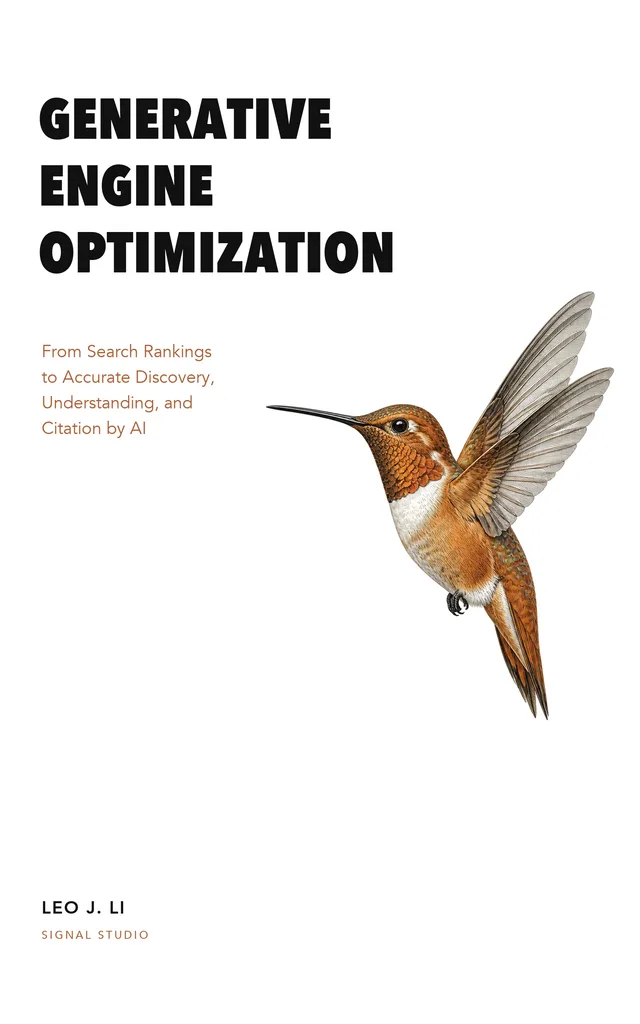
Signal Studio field guide
Generative Engine Optimization
From Search Rankings to Accurate Discovery, Understanding, and Citation by AI
An evidence-first guide to technical content across discovery, retrieval, understanding, citation, and post-answer behavior—without replacing sound SEO with GEO folklore.
For: technical publishers, SEO and content strategists, developer marketing teams
What this book helps you do
This book explains what remains foundational from SEO and what becomes newly observable when answer engines retrieve, synthesize, and cite sources. It replaces GEO hacks with a staged pipeline: access, indexing, retrieval, selection, claim absorption, citation, and behavior—each supported by useful content, explicit evidence, controlled experiments, and honest measurement.
Problems this book helps you solve
- Pages rank for some queries but are absent from relevant AI answers.
- Teams treat GEO as keyword stuffing, schema markup, or an llms.txt shortcut.
- A citation observation cannot show the exact question, interface, date, or visible sources.
- Content makes claims without bounded support, limitations, or a clear update owner.
- Crawler access, indexing, retrieval, source selection, and citation are diagnosed as one problem.
- Syndicated copies create duplicate content and are mistaken for independent corroboration.
Start with a practical question
Use a focused guide for the immediate problem, then return here when you need the complete operating method.
- GEO vs SEO: what actually changes?
- My page is not cited by AI—where should I diagnose first?
- How do I make technical content citable without keyword stuffing?
- Is llms.txt worth adding to a technical site?
- Which AI crawlers should a publisher allow?
- How do I measure AI citations without misleading myself?
- What should a 90-day GEO program deliver?
Decisions you will be able to make
- Which SEO foundations remain prerequisites for visibility in generative search experiences.
- How to structure evidence units that help readers and can be cited without keyword stuffing.
- Where to diagnose a missing citation across access, indexing, retrieval, selection, and synthesis.
- Which crawler purposes to allow and how to keep private publishing assets protected.
- How to record GEO observations without turning one volatile answer into a ranking claim.
- When to expand, repair, maintain, merge, or stop a content program.
Who this book is for
- Technical publishers who need a defensible SEO and GEO operating model.
- Teams building question-led content with first-party artifacts and explicit evidence boundaries.
- Leaders evaluating GEO vendors, tools, experiments, and measurement claims.
Who this book is not for
- Anyone expecting guaranteed rankings, citations, traffic, or book sales from a checklist.
- Programs built around scaled commodity pages, fabricated demand, or inauthentic third-party mentions.
Reading path
- Model visibility after rankingUnderstand discovery, retrieval, synthesis, citation, and behavior as separate observable stages.
- Map the pipelineDiagnose the earliest failed stage before changing content or technical controls.
- Separate GEO from SEOPreserve crawlability, indexing, quality, links, and intent while adding answer-level evidence design.
- Build evidence containersPublish bounded claims, support, artifacts, limitations, authorship, and update history.
- Develop a source ecosystemUse authentic, purpose-specific distribution without manufacturing the appearance of consensus.
- Measure and governRun fixed question sets, archive conditions, review factual support, and choose actions with stop rules.
Optimize for a useful evidence journey
The durable objective is not to write for a model. It is to publish material that a reader can discover, understand, test, cite, and revisit. Answer engines introduce new interfaces and observations, but they do not remove the need for accessible pages, original value, and clear source relationships.
Diagnose stages, not myths
When a page is not cited, start with access and indexing, then test retrieval, selection, claim support, and citation behavior. Changing headings cannot repair a blocked crawler or an unindexed canonical.
Use it with
Maintain a fixed question set, a content derivative ledger, and an evidence map. Record zero-result observations with the same care as successful citations.
Evidence and method
The book distinguishes documented platform behavior from inference and author-created operating models. Search and answer interfaces change, so crawler names, reporting features, and platform controls are dated and linked to primary sources. No individual observation is treated as proof of ranking logic, causal impact, or sales.
Continue with the Kindle edition
Open the Amazon listing to review the current edition and use Read Sample or Kindle Instant Preview before deciding.
Read a sample
Signal Studio does not reproduce manuscript chapters on this site. Open the Amazon listing to use Read Sample or Kindle Instant Preview
Resources
The related guides contain original inline checklists and decision tables; no manuscript excerpt is republished.
Errata
Editorial QA: automated native-English, structure, metadata, and link checks completed . This record is not an independent expert endorsement. Review boundary.