
Question-led guide · decision
Is llms.txt worth adding to a technical site?
A bounded experiment for llms.txt that preserves accessible HTML, sitemaps, robots controls, analytics, maintenance, and honest success criteria.
Direct answer
llms.txt is worth a low-cost experiment when a technical site can keep the file accurate and measure actual fetch or referral behavior. Treat it as an experimental navigation aid, not a standard, ranking factor, crawler permission, or replacement for accessible HTML, internal links, robots.txt, and XML sitemaps. Publish a concise curated file, log requests, and remove or revise it if maintenance exceeds observed value.
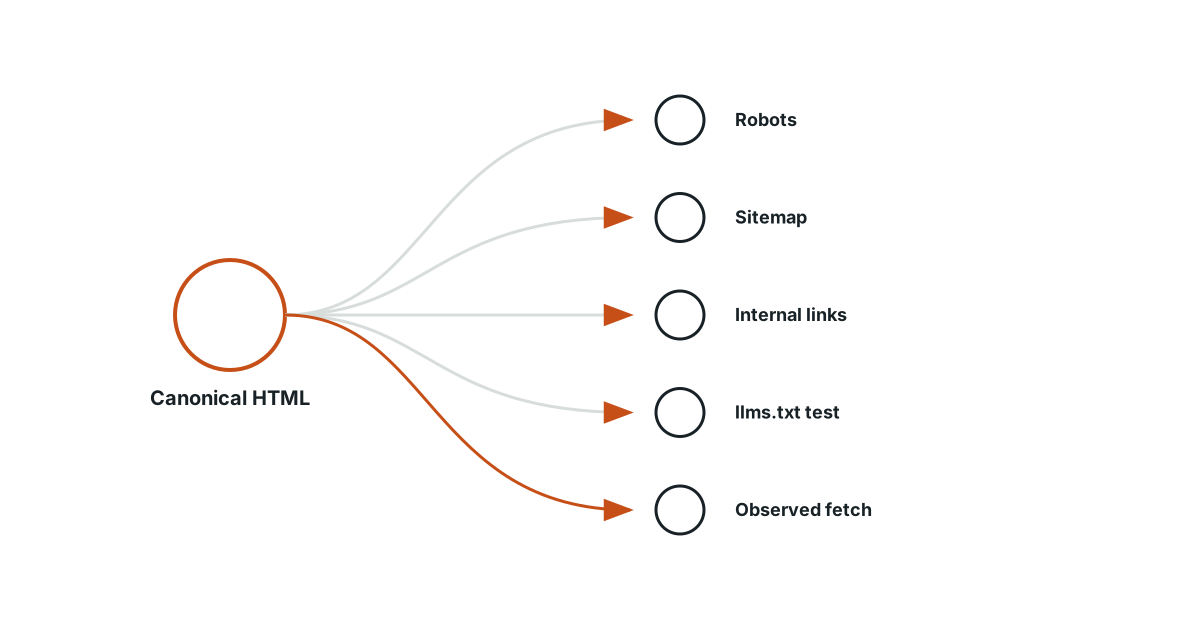
Treat the file as an optional experiment
Use this decision for a technical publisher considering /llms.txt alongside normal site publishing. It applies when the file is inexpensive to generate and can be kept aligned with canonical pages. It does not justify delaying fundamentals such as accessible rendering, internal linking, sitemaps, or useful content.
Why a new convention cannot replace discovery infrastructure
llms.txt is attractive because it offers one concrete GEO file to ship. The visible artifact can create false closure: the team marks “AI optimization” complete without evidence that relevant systems fetch it or that the linked pages answer real questions.
The file can also drift. Slugs change, draft pages remain listed, descriptions exaggerate content, or Markdown mirrors compete with canonical HTML. A useful experiment needs a maintenance contract and observed outcome, even if that outcome is simply reliable machine navigation.
The file is fetched but adds no unique discovery
Logs show a named crawler fetching llms.txt, yet every listed URL was already discoverable through HTML and the sitemap. The team records the observation and keeps maintenance minimal rather than claiming a visibility gain.
Name the consumer and success signal
Before adding the file, verify the site can answer these questions:
- Are the important pages publicly fetchable as complete HTML?
- Do canonical URLs, titles, descriptions, and internal links agree?
- Is an XML sitemap current and submitted where relevant?
- Does robots policy express the publisher’s actual crawler choices?
- Can server or edge analytics distinguish requests to
/llms.txt? - Who will remove stale links and review descriptions?
If the fundamentals are broken, fix them first. llms.txt does not repair JavaScript-only content, blocked assets, thin pages, or ambiguous canonicalization.
Ship a bounded, maintainable test
Generate a concise file from the same content registry that powers navigation and sitemaps. Include site identity, a short purpose statement, and curated links grouped by topic or book. Link to canonical HTML unless a separate Markdown view has a clear maintenance and canonical strategy.
Serve the file with a suitable text content type, stable URL, and ordinary cache behavior. Record fetch count, user agent, response status, and referral or citation observations where available, without collecting unnecessary personal data.
Review after a fixed period. Keep it if it remains accurate at low cost or produces observable use. Revise or remove it if it causes drift, duplication, or no plausible value.
llms.txt experiment card
Complete this experiment card:
| Field | Decision |
|---|---|
| Hypothesis | Which machine-navigation behavior might improve? |
| Baseline | Current crawl, referral, citation, and fetch observations |
| File scope | Included topics/pages and explicit exclusions |
| Canonical policy | HTML/Markdown relationship and link rules |
| Generation | Source registry, validation, deploy, and stale-link checks |
| Observability | Edge/server logs, user-agent caveats, and privacy treatment |
| Success signal | Fetch, downstream referral, operational use, or maintenance value |
| Failure signal | Drift, conflicting metadata, duplication, or material maintenance cost |
| Review | Owner, start, observation period, and keep/change/remove date |
Experimental files advertised as ranking controls
- Calling llms.txt an accepted standard or confirmed ranking factor.
- Listing every URL without curation or descriptions.
- Maintaining the file manually after site navigation becomes data-driven.
- Assuming a fetch proves citation or training use.
- Treating the file as crawler authorization or a substitute for robots.txt.
Evidence
llms.txt is a community proposal for placing a curated Markdown file at a predictable path for language-model-oriented use.
The pinned proposal repository describes the intended file format, examples, parser, and related tooling.
Primary source · official-doc · checked Aug 26, 2026
Limit: It is a proposal and project artifact, not an IETF, W3C, search-engine, or model-provider standard, and adoption is not guaranteed.
Search visibility still depends on crawlable, useful site content and established technical search requirements.
Google Search Essentials describes technical requirements, spam policies, and key best practices for appearing in Google Search.
Primary source · official-doc · checked Aug 26, 2026
Limit: Google's guidance does not validate or reject llms.txt for other systems and does not guarantee indexing.
llms.txt should be governed as a measurable publishing experiment with an owner and falsifiable success criteria.
The experiment card below prevents the file from becoming an unmaintained symbolic GEO task.
Signal Studio author framework · reviewed Aug 26, 2026
Limit: Server logs may not identify downstream model use, and absence of observed fetches does not prove no system consumed the file.
Limitations
Public evidence of broad llms.txt consumption remains limited and can change. User agents can misidentify themselves, caches hide requests, and downstream use may be invisible. The experiment supports an operational decision about the file, not a claim of improved citations.
FAQ
- Should llms.txt contain the full site?
- Prefer a concise curated map to canonical, useful pages with short descriptions. A duplicate full-site dump creates maintenance, freshness, and canonicalization problems without proven benefit.
- Does llms.txt grant permission to train on content?
- No. It is a navigation proposal. Crawler access, contractual permission, copyright, provider controls, and authentication are separate questions.
Related guides
Continue within SEO and GEO for technical sites, or use one of these adjacent diagnostics:
Editorial QA: automated native-English, structure, source-presence, and link checks completed . This record is not an independent expert endorsement. Review boundary.