
Question-led guide · governance
Which AI crawlers should a publisher allow?
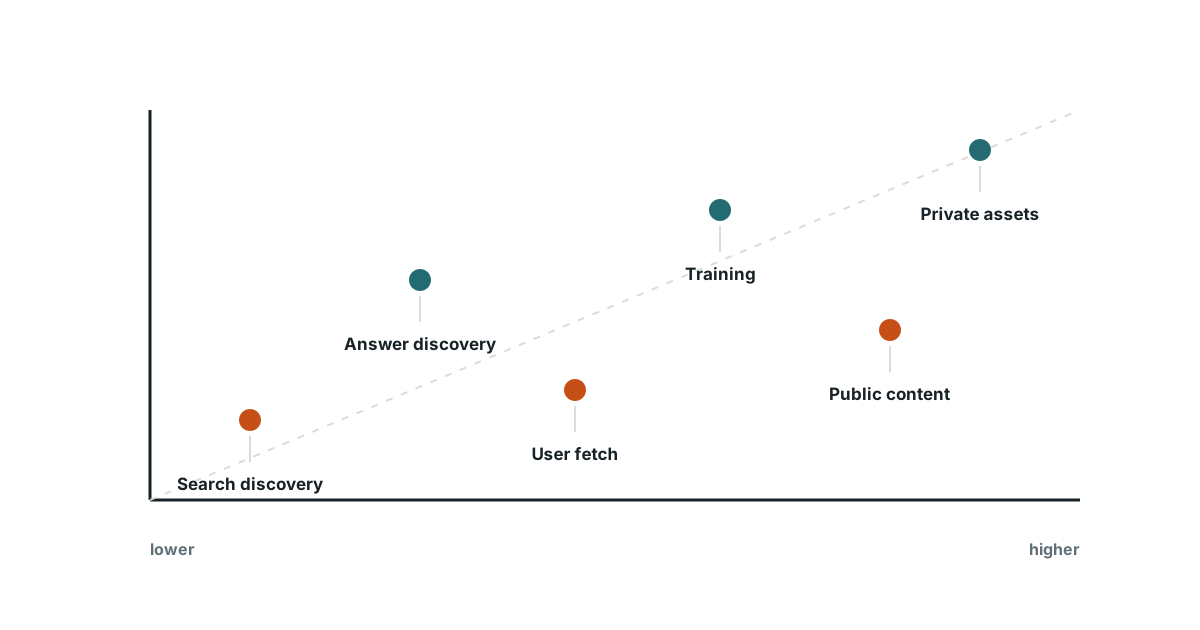
A crawler-purpose matrix separating search discovery, user-requested fetching, training, and other automated access while preserving security boundaries.
Direct answer
Allow crawlers according to publishing purpose and risk. A publisher seeking maximum discovery may allow legitimate search, answer-discovery, user-requested fetch, and training crawlers on public content—as Signal Studio does—while still blocking private, licensed, preview, administrative, and abusive paths. Document each user agent, verify current provider guidance, monitor behavior, and remember that robots.txt is a preference signal, not authentication.
Access policy starts with purpose
This guide helps a technical publisher set public-web crawler policy. Signal Studio’s objective is broad discoverability, so its public book pages, guides, resources, robots file, sitemap, and llms.txt are intended to be accessible to legitimate crawlers. Nonpublic publication assets and administrative paths remain protected by actual access controls.
Why one allow-or-block switch is too coarse
“AI crawler” combines several activities: conventional search indexing, answer retrieval, a user asking a product to open a page, model training, dataset collection, safety analysis, and unknown automation. Providers may publish several user agents because these purposes and controls differ.
Two simplistic policies follow. Blocking everything can undermine the publisher’s discovery goal. Allowing everything without path boundaries can expose licensed previews, unpublished manuscripts, query endpoints, or costly dynamic resources. Purpose and content class must be considered together.
Public guides open, manuscript assets closed
Search discovery, answer discovery, and user-triggered fetchers may access public HTML and images. Unpublished manuscripts, source archives, admin paths, and private preview assets remain unavailable regardless of crawler identity.
Path controls remain useful even under a broad public-content policy:
User-agent: *
Allow: /
Disallow: /private/
Disallow: /manuscripts/
Disallow: /admin/
The example expresses asset boundaries, not a universal policy. Named crawler directives should be added only after verifying current identifiers and deciding what each purpose may access.
Map agents, assets, rights, and operational cost
Inventory the site’s routes and classify them: public canonical content, public assets, user-specific content, administration, staging, licensed samples, unpublished files, search/query endpoints, and generated variants. Verify that private classes are actually authenticated.
Then inventory crawler directives from current provider documentation. Record user agent, stated purpose, verification method, desired policy, and last review. Compare edge logs with the declared list, but treat user-agent strings as claims rather than proof.
Publish explicit purpose-based controls
Start from the publishing objective. For maximum public discovery, allow documented legitimate crawlers on canonical public content and necessary rendering assets. Keep canonical HTML consistent for every crawler and human; do not serve deceptive crawler-only text.
Apply explicit disallows to paths that should not be fetched, while moving truly private resources behind authentication. Rate-limit abusive behavior at the edge based on verified signals and load, without assuming every unknown bot is a known provider.
Version robots policy and test it after deployment. Monitor response codes, crawl concentration, bandwidth, referrals, and indexing/citation observations. Revisit provider docs on a schedule and after a crawler announcement.
Crawler-purpose matrix
Maintain this matrix:
| User agent / fetcher | Stated purpose | Public content | Private/licensed content | Verification | Monitoring | Last checked |
|---|---|---|---|---|---|---|
| Search discovery | Index and surface pages | Allow if desired | Authenticate/block | Provider method | Crawl/referral | |
| Answer discovery | Retrieve for generated answers | Allow if desired | Authenticate/block | Provider method | Crawl/citation | |
| User-requested fetch | Open a URL at user request | Allow public routes | Enforce user auth | Request/provider signals | Fetch/errors | |
| Training crawler | Collect eligible public content | Allow or disallow by policy | Authenticate/block | Provider docs | Crawl volume | |
| Unknown automation | Undeclared | Risk/load policy | Deny private paths | Network/behavior | Abuse/load |
For each row, link the official documentation and record the exact robots group deployed.
Robots policies copied without an editorial decision
- Using one policy for public articles and private manuscript assets.
- Assuming a crawler name proves identity or purpose.
- Blocking rendering assets required to understand public pages.
- Treating robots.txt as authentication, copyright license, or enforceable data deletion.
- Changing crawler policy without checking production response codes and sitemap access.
Evidence
The Robots Exclusion Protocol standardizes how crawlers discover and interpret access rules but does not provide access authorization.
RFC 9309 specifies robots.txt location, groups, matching, parsing, caching, and protocol semantics.
Primary source · standard · checked Aug 26, 2026
Limit: Compliant robots directives are voluntary crawler instructions and do not secure confidential resources or control downstream copies.
Providers can operate different crawler and fetcher user agents for distinct purposes.
Google documents common crawlers, special-case crawlers, and user-triggered fetchers and explains user-agent verification.
Primary source · official-doc · checked Aug 26, 2026
Limit: The list is Google-specific and mutable; it does not describe every AI provider or guarantee a crawl.
OpenAI documents separate user agents and controls associated with search, user-requested actions, and training-related crawling.
OpenAI's publisher FAQ explains its documented crawlers, referral reporting, controls, and publisher considerations.
Primary source · official-doc · checked Aug 26, 2026
Limit: The FAQ is provider-maintained and can change; it does not create a universal legal permission framework.
Limitations
Crawler identities and policies change, malicious bots can spoof user agents, and some systems fetch through user-triggered or third-party infrastructure. Robots rules cannot govern data already copied elsewhere. Recheck official documentation and legal requirements for the publisher's jurisdiction and contracts.
FAQ
- Does allowing every documented AI crawler maximize citations?
- It removes one possible access barrier. Selection still depends on discovery, indexing, retrieval, relevance, source preferences, answer generation, and the quality and support of the page.
- Can I protect private content with robots.txt?
- No. Put private or licensed assets behind authentication and authorization, avoid public links and indexes, and apply storage and CDN controls. robots.txt can reveal paths and is not a security boundary.
Related guides
Continue within SEO and GEO for technical sites, or use one of these adjacent diagnostics:
Editorial QA: automated native-English, structure, source-presence, and link checks completed . This record is not an independent expert endorsement. Review boundary.