
Question-led guide · measurement
How do I measure AI citations without misleading myself?
A reproducible GEO observation protocol for fixed questions, run conditions, citation support, source accuracy, visibility, behavior, and uncertainty.
Direct answer
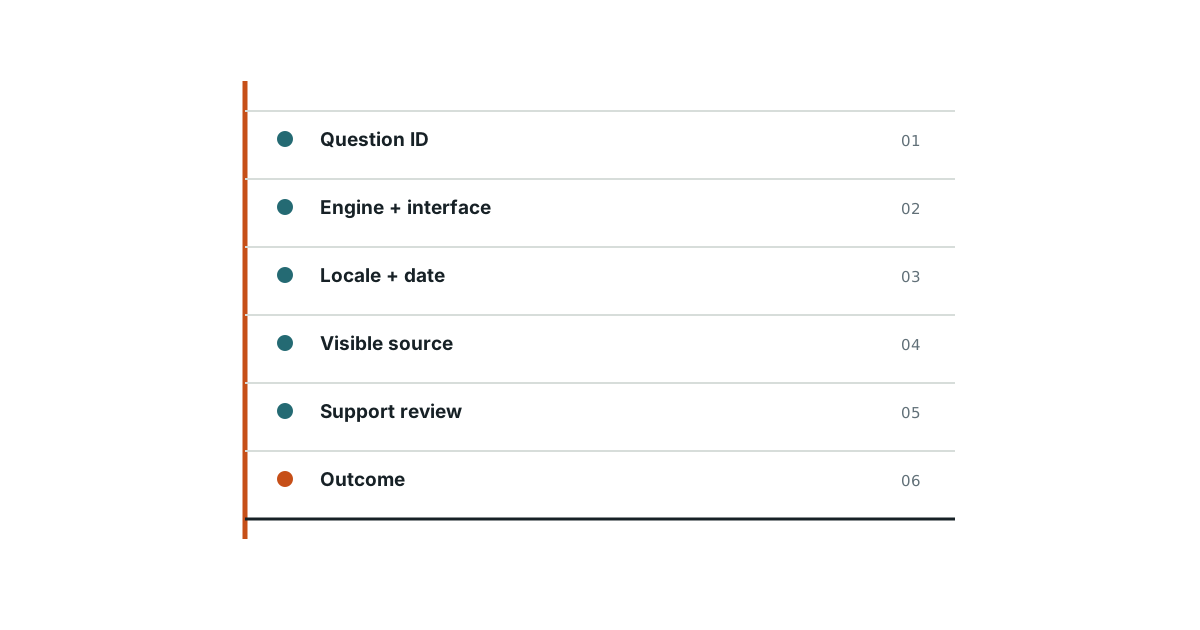
Measure AI citations with a fixed, versioned question set and a repeatable observation protocol. Record product, mode, account state, locale, date, model if exposed, web access, prompt, trials, answer, links, quoted support, rank or prominence, and referrals. Separate mention, citation, correct support, and user behavior. Report denominators and uncertainty; a screenshot or before-after count does not prove your content change caused the result.
Observation needs conditions and a denominator
Use this protocol to monitor whether public technical content appears, is linked, and supports generated answers across selected AI search or assistant products. The objective is reproducible observation and program learning. It is not reverse engineering and does not establish a universal market-share metric.
Why screenshots alone cannot support a trend
GEO results are easy to cherry-pick. A team tries several prompts, keeps the screenshot that cites the site, and compares it with a remembered baseline. Product mode, locale, login state, web access, conversation history, and time are unrecorded. The citation may not support the nearby claim, and no denominator is reported.
Dashboards create a different temptation. Citation counts are useful platform observations, but definitions, coverage, and query inventory are controlled by the provider. A rising count may reflect product rollout, demand, indexing, more pages, or content changes.
12 citations out of what?
Twelve visible citations came from 40 fixed questions in one interface, locale, and week; five supported the answer materially. The report keeps visible-citation and supported-citation rates separate and archives the exact conditions.
Store the observation itself, not only an aggregate chart:
{"question_id":"Q-GEO-017","engine":"example-ai","interface":"web",
 "locale":"en-US","observed_at":"2026-08-26T09:20:00Z",
 "source_url":"https://signalstudio.cc/guides/geo-vs-seo/",
 "visible_citation":true,"material_support":"partial","visit_observed":false}
The engine label above is illustrative. A production record also needs the exact product surface and any available model or mode information.
Define question, interface, source, and support states
Audit the current report. For every percentage or trend, find the numerator, denominator, question set, products, modes, observation dates, and missing data. Re-open sampled citations and classify support: exact, partial, topic-only, contradictory, stale, or unavailable.
Check whether questions changed after content was published. If a team replaces failed prompts with favorable variants, longitudinal comparison is invalid. New discovery questions can be added as a separate cohort without rewriting the baseline.
Run a reproducible citation protocol
Create a stratified question set from real reader problems: informational, diagnostic, comparison, recommendation, and brand-aware queries. Freeze exact wording for the longitudinal lane and version any changes. Run repeated observations under documented conditions at a sustainable cadence.
Store answer snapshots or structured notes within product terms. For each source appearance, record page, claim, support classification, prominence, and whether the answer recommends, neutrally cites, or contradicts the source. Join available webmaster and referral data, keeping provider definitions separate.
Use content changes as hypotheses. Stagger updates where practical and compare matched pages or queries, but describe causal conclusions conservatively.
GEO observation record
The observation protocol records:
| Group | Fields |
|---|---|
| Question | Stable ID, exact wording, intent, language, audience, and cohort |
| Run | Product, mode, account/login, locale, date/time, model if shown, and web state |
| Trial | Fresh session/history rule, sequence, errors, and answer artifact |
| Appearance | Mention, citation/link, cited URL, position/prominence, and surrounding claim |
| Support audit | Exact/partial/topic-only/contradictory/stale/unavailable plus reviewer |
| Accuracy | Correct book/author/title/claim and material omissions |
| Behavior | Referral, landing page, engagement event under privacy policy, and conversion boundary |
| Reporting | Numerator, denominator, missingness, uncertainty, product-specific definition, and date |
| Change log | Page update, hypothesis, comparison plan, and decision |
Percentages whose test set changed underneath them
- Reporting the best screenshot from an undisclosed prompt search.
- Counting a source link without checking the claim it supports.
- Mixing product modes, countries, languages, and logged-in states in one rate.
- Treating a provider preview dashboard as a complete cross-platform measure.
- Claiming a page edit caused a change without stable questions or comparison evidence.
Evidence
Bing Webmaster Tools has introduced AI Performance reporting intended to show cited URLs and related AI-search visibility metrics.
Bing's official announcement describes the public-preview AI Performance experience, citations, cited pages, and grounding-query reporting.
Primary source · official-doc · checked Aug 26, 2026
Limit: It is a Bing-specific preview, definitions and coverage can change, and the dashboard does not prove a publisher action caused a citation.
Citation evaluation should distinguish whether cited material supports the answer and whether answer claims receive adequate citations.
The verifiability paper defines and applies citation correctness and completeness concepts to generative-search answers.
Primary source · paper · checked Aug 26, 2026
Limit: The audited systems are historical and the study does not provide publisher-side causal attribution.
GEO reporting should keep citation selection, supported use, visibility, and downstream behavior as separate observable stages.
The protocol below prevents a raw link count from being presented as accurate recommendation or business impact.
Signal Studio author framework · reviewed Aug 26, 2026
Limit: Products expose incomplete data, personalization and randomness are difficult to control, and some citations or referrals are unobservable.
Limitations
AI products, retrieval indexes, models, interfaces, personalization, and source-display rules change quickly. Automated querying may violate product terms or trigger anti-abuse systems. Use lawful sampling, protect accounts, and frame results as dated observations.
FAQ
- What is the difference between a mention and a citation?
- A mention names the brand, author, book, or concept. A citation exposes a source reference or link. A supported citation additionally entails the associated claim without misrepresenting the page.
- Can referral traffic validate GEO success?
- It measures one downstream behavior and should be reported. It misses unclicked influence and can be difficult to attribute, so combine it with citation-support audits and fixed-question observations.
Related guides
Continue within SEO and GEO for technical sites, or use one of these adjacent diagnostics:
Editorial QA: automated native-English, structure, source-presence, and link checks completed . This record is not an independent expert endorsement. Review boundary.