
Question-led guide · planning
What should a 90-day GEO program deliver?
A practical 90-day GEO program that ships technical access, evidence-backed content, measurement baselines, distribution experiments, and an executive decision.
Direct answer
A 90-day GEO program should deliver a verified technical-access baseline, an intent map, a small portfolio of independently useful evidence pages, author and entity consistency, crawler and sitemap policy, a reproducible citation-observation baseline, ethical distribution experiments, and an executive decision. The final memo should say what was shipped, observed, unsupported, stopped, maintained, and tested next—not promise AI recommendations or rankings.
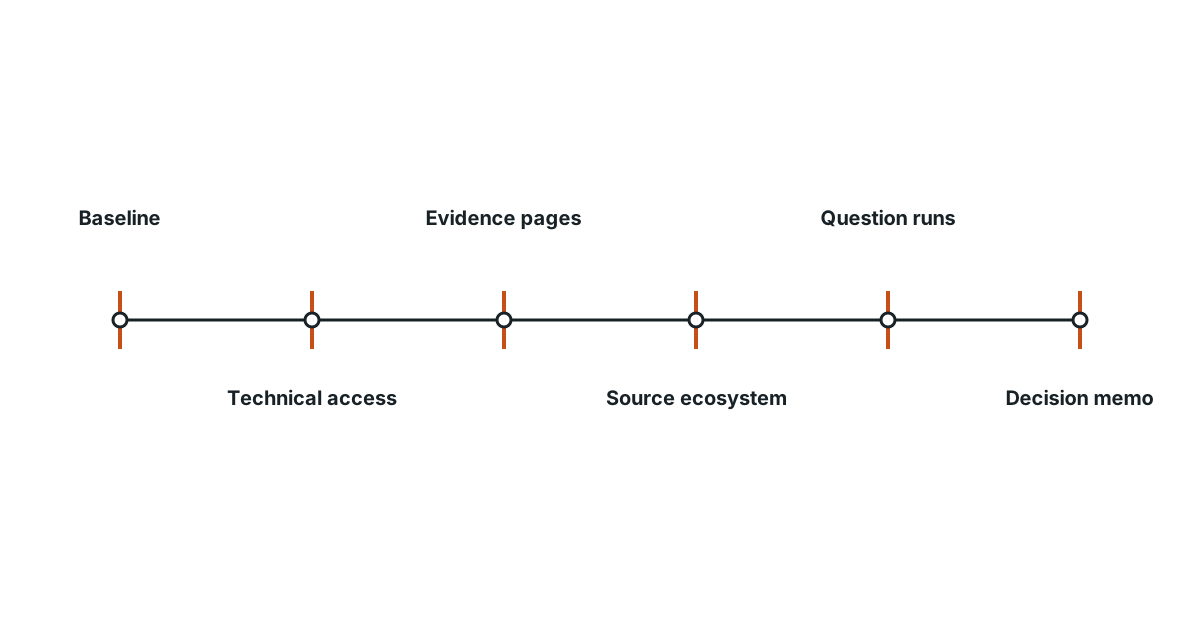
A program should produce decisions, not promises
Use this plan for a technical publisher with a real corpus and the ability to improve its own site. It includes external distribution, but the canonical knowledge base remains the publisher-controlled site. Day counts are operating windows, not claims about how fast search systems respond.
Why publishing volume is a weak milestone
GEO programs often begin with article volume or a crawler file. Neither establishes that the site answers distinct questions, exposes evidence, is technically accessible, or can measure what changed. External promotion then amplifies weak pages or triggers spam controls.
A 90-day frame is useful because it forces deliverables and a decision. It should preserve delayed outcomes: sitemaps may still process and citations may appear after the program. “No result yet” is an observation, not a reason to invent a success metric.
Week 30 changes because access failed
The baseline discovers that important pages are not consistently indexable. The program moves technical repair ahead of article expansion, then uses a fixed question set to decide which evidence gaps justify new content.
Sequence technical, content, source, and measurement work
Before day one, record baselines for crawlability, index coverage, canonical URLs, sitemaps, structured data, page performance, referral analytics, branded search, citations, author identity, and existing backlinks. Audit content by user intent and evidence quality.
Identify overlap. If several pages target the same recommendation or definition, choose a canonical owner and redirect, consolidate, or sharpen the others. Map every planned page to a question, audience, decision, unique artifact, source set, and explicit exclusion.
Deliver an auditable operating baseline
Days 1–30: foundation. Fix public HTML, canonicalization, sitemaps, robots policy, metadata, entity/author consistency, analytics, and evidence records. Freeze a question set and observation protocol. Publish a small set of highest-confidence pages.
Days 31–60: portfolio and distribution. Expand only after editorial review. Add internal topic clusters and original artifacts. Republish selected ideas natively on Medium with canonical or clear source attribution where the platform supports it. Participate on Reddit by answering community questions completely, disclosing affiliation when relevant, and linking only when the page supplies material additional value.
Days 61–90: measure and decide. Review crawl/index status, webmaster reports, citation-support observations, referrals, qualitative responses, and maintenance burden. Improve weak evidence or merge competing pages. Produce the decision memo and a next-quarter experiment queue.
Ninety-day decision memo
The executive decision memo contains:
| Section | Required contents |
|---|---|
| Objective | Audience, business/reader outcome, scope, and prohibited tactics |
| Baseline | Technical, content, authority, citation, referral, and measurement state |
| Shipped assets | Canonical pages, artifacts, metadata, crawler files, and distribution posts |
| Quality proof | Intent review, sources, limitations, technical review, and editorial audit |
| Observations | Crawling, indexing, citations, support accuracy, referrals, and community response |
| Uncertainty | Processing delays, missing data, platform changes, and unsupported claims |
| Decisions | Keep, revise, consolidate, stop, or expand—with owner and rationale |
| Next experiments | Hypothesis, control/comparison, cost, risk, success/failure signal, and review date |
Roadmaps built around vanity citation counts
- Setting a publishing quota before source and review capacity.
- Treating traffic, mention, citation, supported citation, and recommendation as the same metric.
- Posting near-duplicate promotional articles across communities.
- Changing questions and measurement conditions after seeing results.
- Declaring success or failure while search-console and sitemap processing remain incomplete.
Evidence
Google's AI-search guidance ties eligibility and performance to existing crawl, index, content, structured-data, and user-experience fundamentals.
The guide describes technical and content practices for Google's AI features and rejects the need for special AI files or schema to qualify.
Primary source · official-doc · checked Aug 26, 2026
Limit: It is Google-specific, does not disclose ranking systems, and does not guarantee appearance.
End-to-end GEO evaluation should account for retrieval, reranking, and generation rather than infer impact from a fixed supplied context.
SAGEO Arena proposes an end-to-end environment for evaluating GEO interventions across search-augmented generation stages.
Primary source · paper · checked Aug 26, 2026
Limit: It is a controlled research environment and does not expose proprietary commercial ranking or answer systems.
A bounded program should end with a keep, change, stop, or expand decision supported by versioned artifacts and observations.
The executive decision memo below prevents a 90-day content sprint from becoming an indefinite volume target.
Signal Studio author framework · reviewed Aug 26, 2026
Limit: Ninety days may be too short for indexing, citation, referral, or business effects, so delayed observations must remain open rather than manufactured.
Limitations
Search and answer systems may take longer than ninety days to discover or reuse content. Attribution is incomplete, platform policies change, and distribution experiments can create reputational risk. The program supports a learning decision, not guaranteed visibility.
FAQ
- How many articles should the program publish?
- Publish only the number that can pass intent, evidence, usefulness, technical, and editorial gates. Coverage and independent value matter more than reaching an arbitrary volume in ninety days.
- Should Medium and Reddit be part of the program?
- They can be distribution experiments when the content is native to the community and useful without the link. Use canonical or attribution strategy carefully, disclose relationships, and never automate spam.
Related guides
Continue within SEO and GEO for technical sites, or use one of these adjacent diagnostics:
Editorial QA: automated native-English, structure, source-presence, and link checks completed . This record is not an independent expert endorsement. Review boundary.